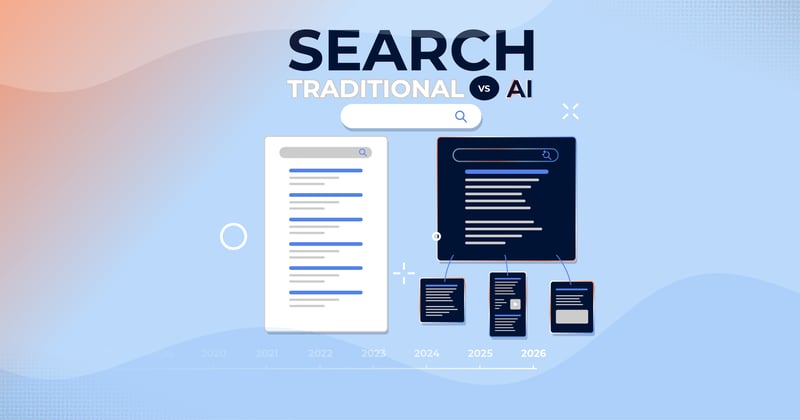
Search is no longer a list of blue links. It’s becoming an answer layer, one where AI systems interpret the user’s intent, compare options, evaluate data across sources, and deliver a recommendation without requiring the user to browse at all. Google’s rollout of Gemini 3 into AI Mode, Maps, and Lens accelerated this shift, while ChatGPT (GPT-5 series) continues to shape how people search outside of Google’s ecosystem.
This change isn’t theoretical. OpenAI reports that 100M+ people use ChatGPT weekly, and on Google’s side, AI Overviews now appear in over 13% of queries, nearly doubling in just three months.
What’s Really Happening
People increasingly type or speak full questions, get a synthesized answer, and only then decide whether they even need to click. In many journeys, AI shapes the shortlist and Google still gets the last click for reviews, directions, or booking.
That’s why the conversation around the right AI search optimization tool should focus less on gaming algorithms and more on making your business the easiest for AI to understand, verify, and trust across this whole journey.
AI Is Replacing the Comparison Stage
Traditionally, users compared restaurants, gyms, stores, or services through multiple tabs and maps. Now they ask:
- “Where’s the closest gym with sauna and parking?”
- “Is this café worth going into?” (asked through Lens)
- “Which hair salon has availability tomorrow after 4pm?”
- “Find me the best value sushi place near me.”
Gemini or GPT performs the evaluation, checks available data, interprets reviews, scans attributes, and narrows it down to one or a few confident matches. The recent studies found that 58.5% of Google searches end without a click, which is a direct consequence of this shift toward AI answers and “good enough” information on the results page.
In practice, people often let AI do the heavy comparison work, then jump into Maps or a website just to confirm the final choice. Visibility today is less about “ranking” in a long list and more about being the cleanest, clearest, most verifiable match to the user’s intent when AI builds that shortlist.
Gemini vs GPT: Two AI Systems, Two Different Visibility Requirements
Both are also shifting people away from the old “search box + 10 blue links” pattern towards conversational interfaces. Now people type or speak full questions, follow up with clarifiers, and expect the system to keep context across turns, whether that’s in Google’s AI Mode or ChatGPT’s chat window. source: https://blog.google/products/search/generative-ai-google-search-may-2024/
How Gemini Evaluates Your Brand
Because Gemini now powers both AI Overviews and AI Mode, these signals don’t just affect “experimental” surfaces. They influence which locations appear in AI summaries, which brands are suggested in conversational follow-ups, and which businesses are shown when someone points their camera at a street and asks, “Is this place worth going into?”
Gemini gives significant weight to:
- Google Business Profile accuracy
- Attributes and amenities (parking, atmosphere, accessibility, etc.)
- Photo recency and relevance
- Location-specific reviews and patterns
- Structured local landing pages
- Maps interactions
- Consistency across Google products
In short, Gemini rewards recency, accuracy, and completeness.
 source: https://openai.com/index/introducing-chatgpt-search/
How GPT Evaluates Your Brand
GPT rewards richness and clarity of information, not just correctness. At the same time, research and practitioner experience show that AI systems tend to reward consensus more than originality: they’re more likely to surface perspectives that multiple trusted sources agree on than a single, lone opinion, which makes consistent signals across the wider web even more important
GPT’s browsing and answer engine rely on these signals:
- Website depth and clarity
- Structured data (schema)
- Multi-source consistency
- High-quality, explanatory content
- Reputation across the wider web
- E-E-A-T style authority cues
GPT rewards richness and clarity of information, not just correctness.
Where Gemini and GPT Overlap
Both systems trust businesses that are:
- consistent across platforms
- easy to verify
- frequently updated
- supported by real customer signals (photos, reviews, and content that match reality)
The Question Brands Should Be Asking Isn’t “How Do We Rank?”
The real question is: “Is our business giving AI enough clarity and confidence to recommend us?”
Even if a brand is large, AI will choose the business with fewer uncertainties.
Interestingly, this also applies to reviews: AI models look for natural patterns, not perfection. A large number of recent, detailed reviews and a strong but realistic average (for example, 4.6-4.8 out of 5) often looks more trustworthy than a small number of identical five-star reviews.
AI removes businesses from consideration when it sees:
- mismatched opening hours
- duplicate locations
- missing amenities
- inconsistent or outdated information
- low photo freshness
- weak or stale reviews
- unclear store-level identity
- unstructured landing pages
How to Choose the Right AI Search Engine Optimization Tool in 2026
Now that Gemini, GPT, and multimodal AI search experiences are shaping how people discover businesses, choosing an AI search optimization tool has become essential for multi-location brands. But the market is noisy, full of tools promising shortcuts or “AI visibility boosts” that don’t reflect how AI systems actually work.
The right tool isn’t the one that only generates more content, automates posting, or vaguely claims to “influence AI overviews.” The right tool is the one that helps AI trust your business more by fixing the underlying signals AI actually uses: data accuracy, recency, structure, and customer proof.
A good AI search optimization tool should help you:
Maintain accurate and unified business data across all networks
AI systems lose confidence when they see different hours, mismatched names, or outdated locations. Tools that safely sync data across Google, Apple, Meta, Bing, and directories are essential.Create structured, location-specific landing pages
AI needs a unique, verifiable identity for each branch. If every location points to the same general page, Gemini and GPT struggle to match user intent to the right store.Strengthen recency signals across reviews, photos, and updates
AI heavily favors businesses that look “alive.” Tools that help encourage, centralize, and monitor review activity—and freshness across photos and posts—directly improve discoverability. Provide complete, trustworthy attributes and amenities
AI uses attributes (parking, accessibility, atmosphere, services) to match detailed intent queries. Tools that help ensure every location’s attributes are complete give a massive advantage.Highlight what each location is “known for”
Gemini and GPT both extract sentiment patterns. A good tool should help you monitor these patterns and ensure each branch has the social proof and clarity needed to stand out.Prevent duplicates, broken links, and outdated listings
These issues are invisible to users but highly visible to AI. A strong tool should detect and resolve inconsistencies automatically.Compare performance across search ecosystems (Google, Apple, Meta)
AI search isn’t just Google anymore. A tool should give you visibility across networks to understand how demand and behavior shift in each ecosystem.Keep all this accurate at scale
Most brands can manually fix one listing. Managing hundreds or thousands of locations requires automation, auditability, and a single source of truth.Where PinMeTo Fits in Your AI Search Optimization
PinMeTo ensures your business is accurate, consistent, and structured everywhere, so AI systems like Gemini and GPT can confidently interpret and recommend your locations instead of quietly skipping them in favor of a clearer competitor.
Here’s how it supports the signals AI relies on:
- PinMeTo Listings keeps opening hours, addresses, services, and attributes consistent across Google, Apple, Meta, Bing, and other key platforms. Data conflicts are one of the most common reasons AI skips a location entirely. When information doesn’t match, AI doesn’t guess, and moves on.
- Locator & Local Pages give every location a structured, verifiable landing page linked to validated business data. These pages help Gemini and GPT clearly connect user intent, such as “open now,” “near me,” or “has parking,” to the correct physical store instead of relying on broad brand-level assumptions.
- PinMeTo Reviews support review recency, sentiment clarity, and store-level credibility. AI systems look for natural consensus across customer feedback to understand what a location is consistently known for. Perfect ratings matter far less than clear, recurring patterns.
- PinMeTo Posts add ongoing freshness and local context. Regular, location-specific updates help AI interpret what a place feels like right now, which is increasingly important as AI-generated answers become more real-time and experience-driven.
Beyond visibility signals, AI-powered Insights and the AI Agent help teams understand how locations perform across AI-influenced discovery paths. Instead of guessing why one store appears more often than another, teams can spot patterns in visibility, engagement, data completeness, or sentiment — and address issues before they affect AI confidence.
How Multi-Location Brands Can Prepare for AI Search in 2026
Brands that perform well in AI search do a few foundational things extremely well:
- Keep location data accurate across all platforms
- Update photos regularly
- Maintain fresh, authentic reviews
- Ensure attributes and amenities are complete
- Use structured, clean local landing pages
- Avoid duplicates, data conflicts, and outdated hours
- Distinguish each location clearly and consistently
Dive deeper into the most effective AI search optimization tactics
To Sum Up
AI search is pushing discovery into a new era where users expect immediate, contextual recommendations. Gemini and GPT synthesize information, compare businesses, and choose on behalf of the user. In practice, that means a lot of your future customers will never see a long list of options, but one or two strong suggestions instead, generated by AI on top of the data you’ve already published.
In this environment, the brands that win aren’t the biggest. They’re the ones that are easiest for AI to interpret, verify, and match to intent. And that’s something any business can achieve with the right foundations and the right AI search engine optimization tool supporting data clarity across platforms.
FAQ: AI Search Engine Optimization Tool
What is an AI search engine optimization tool?
It’s a tool that helps businesses improve their visibility in AI-driven search systems like Gemini, GPT, and Perplexity by ensuring accurate business data, structured landing pages, fresh content, and consistent signals across networks.
How do Gemini and GPT differ when recommending businesses?
Gemini relies heavily on Google Business Profiles, Maps signals, and structured local data. GPT prioritizes website clarity, rich content, and multi-source consistency. Both reward accurate, well-maintained profiles.
Why does AI sometimes skip or ignore certain business locations?
AI excludes locations with outdated hours, inconsistent data, missing attributes, unclear offerings, or weak recency signals. Any conflict reduces recommendation confidence.
How can brands increase visibility in AI search?
Maintain complete and consistent listings, build structured landing pages, refresh photos, request reviews regularly, and ensure each location has a clear identity across platforms.
How does PinMeTo support AI search optimization?
PinMeTo centralizes business information, syncs updates across platforms, creates structured local pages, maintains review recency, and helps each location stay up to date making it easier for AI to interpret and recommend them.
Lily Adamyan, December 10