How to Make Your Multi-Location Website Agent-Ready in 2026
Originally published
- Local SEO
- Multi-Location
- How-to Guides
- AI Search
Something changed in how people find businesses. Not a gradual shift, but a structural one. ChatGPT alone now serves more than 5 billion monthly visits to 900 million weekly active users, and Gemini’s monthly traffic grew 647% to 2 billion visits in the year ending March 2026. More of those visits involve local queries: “Find me a dentist with good reviews near Kungsholmen” or “Which car dealership in Gothenburg has the best service ratings?” Inside ChatGPT, prompts with local intent now trigger a live web search 59% of the time, which makes the question “what does your site return when an agent asks?” a direct driver of foot traffic.

The AI agent doesn’t browse your website the way a human does. It queries protocols, reads structured data, and invokes tools. If your site can’t respond to those requests, the agent recommends someone who can.
This is what “agent-ready” means: your website is built so AI systems can discover it, understand it, and interact with it without human guidance.
For multi-location brands, the stakes are higher than for anyone else. You’re not optimizing one page or one location. You’re making hundreds or thousands of locations visible to a new class of digital visitors that don’t use browsers the way humans do.
How Is AI Agent Discovery Different from Traditional Search?
Search engines crawl HTML, follow links, and build an index. AI agents do something fundamentally different. They:
- Read structured data like JSON-LD and Markdown instead of parsing messy HTML
- Query protocols to discover what a website offers before interacting with it
- Invoke tools to take actions (booking, comparing, searching) rather than just reading pages
- Connect to services through standardized protocols like MCP to access live business data
This shift means the rules have changed. A website that ranks well on Google may be completely invisible to an AI agent if it doesn’t implement the discovery standards those agents rely on.
The good news: the standards exist, they’re open, and you can implement them today.
What Is the Agent Readiness Stack?
Agent readiness is not a single checkbox. It’s a stack of complementary standards, each handling a different aspect of how AI agents interact with your website.
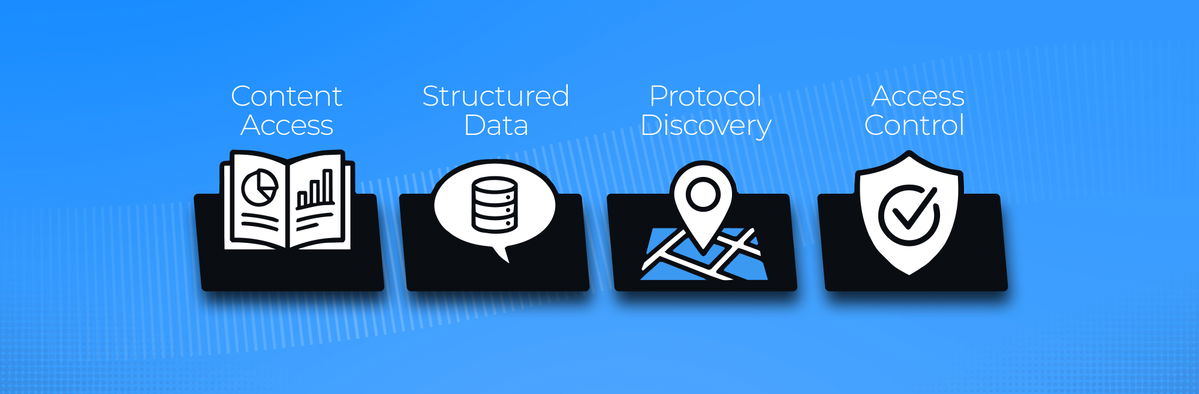
Layer 1: Content Access
Can AI agents read your content efficiently?
robots.txt with explicit AI bot rules is the starting point. The major AI crawlers all advertise their own user agents, and the simplest, best-supported thing you can do today is name them explicitly and decide whether to Allow or Disallow each one:
User-agent: GPTBot
Allow: /

User-agent: ClaudeBot
Allow: /

User-agent: PerplexityBot
Allow: /

User-agent: Google-Extended
Allow: /

User-agent: Applebot-Extended
Allow: /
For most multi-location brands, allowing all of these is the right call. You want to be cited. These rules are standard RFC 9309 directives that the named crawlers all read, so this layer rests on well-established ground.
Content Signals is a newer, more granular layer on top of robots.txt. The Content Signals draft (an IETF Internet-Draft by Michael Tremante and Leah Romm at Cloudflare) adds Content-Signal directives that declare how AI may use your content, not just whether it can fetch it:
User-agent: *
Content-Signal: ai-train=yes, search=yes, ai-input=yes
Allow: /
This tells AI crawlers: you may use our content for model training (ai-train), building search indexes (search), and generating AI-powered answers (ai-input). Each User-Agent block gets its own Content-Signal, so you can set different permissions for different crawlers.
The proposal is promising and worth keeping an eye on. It’s still an early IETF draft, so adoption is uneven: Cloudflare has built it into the robots.txt they manage for sites on their network, while the major AI labs haven’t publicly confirmed yet whether they read the Content-Signal directive. Adding it today is more about declaring your intent than enforcing it, which is a perfectly reasonable thing to do.
One small heads-up: until late May 2026, adding Content-Signal lines surfaced a cosmetic “robots.txt is not valid” notice in PageSpeed Insights, because the validator only knew about the directives in the original robots.txt RFC. Google’s validator has since been updated, and as of 2026-05-26 the warning no longer fires. Some older SEO tools may still flag it, but the directive is safe either way: RFC 9309 tells crawlers to ignore lines they don’t recognize, so it won’t hurt your search ranking or AI access.
Markdown content negotiation gives AI agents clean, structured content instead of raw HTML. When an agent sends Accept: text/markdown in its HTTP request, the server returns Markdown for the same canonical URL while browsers continue to receive HTML. The Markdown can be generated on the fly at the edge (Cloudflare’s approach) or pre-built as a sibling .md file at the origin (the pattern Vercel, Sentry, Sanity and this site use). Either way, there is one URL for content and the response varies on the Accept header.
Why agents care. The case for Markdown is mostly economics. Every token an agent reads or generates costs compute, and that translates directly into latency, API spend and bandwidth. A simple Markdown heading costs about three tokens, while the equivalent HTML markup uses twelve to fifteen, per Cloudflare’s announcement of “Markdown for Agents”. Across a whole page, clean HTML typically runs two to three times more expensive than the same content in Markdown, and real-world HTML with CSS, JavaScript and tracking can balloon to eight to ten times more, per Beam.ai’s HTML-vs-Markdown analysis. Cloudflare measured their own announcement post at 16,180 tokens as HTML and 3,150 as Markdown, an 80% reduction. Vercel reported a similar story from the bandwidth angle: the HTML version of a page on their site weighed around 500KB while the Markdown version came in at 3KB, a 99% payload reduction on top of the token savings. The two numbers measure different things (tokens vs bytes) and come from different vendors with different methods, but they triangulate the same story. At frontier-model prices, that delta adds up quickly across a session, and the compute and bandwidth saved can be spent on more reasoning, more tool calls, or simply on a cheaper request.
The savings also cascade past cost. Fewer tokens means more room in the agent’s context window for the actual task, faster time-to-first-token because there is less to fetch and parse, and a cleaner signal-to-noise ratio for retrieval (no nav, ads, modals or layout wrappers competing with the content). Markdown is also the format LLMs were largely trained on (GitHub READMEs, technical documentation, generated outputs), so it tends to be their most fluent input by default. Cloudflare even ships an x-markdown-tokens response header alongside the converted output, documented in Cloudflare Fundamentals, so the agent can check the token count up front and decide whether the document fits its context window or needs chunking.
Who supports it today. Per the acceptmarkdown.com status tracker, client-side support started in coding tools and is now spreading into general-purpose work surfaces. Anthropic’s Claude sends Accept: text/markdown from Claude Code and from Cowork in the Claude desktop app (verified in our own request-log testing at the time of writing), which means Markdown content negotiation is no longer purely a coding-agent concern: Cowork is the research, drafting and browsing surface inside the desktop app, so any business document, competitor lookup or article a Claude user asks Cowork to fetch goes through this path. The regular chat experience in the desktop app and at claude.ai does not send the header yet. Cursor, OpenCode and OpenClaw send it too. OpenAI’s Codex CLI supports it partially, fetching the canonical URL as HTML first and then looking for a <link rel="alternate" type="text/markdown"> in the head before requesting the sibling Markdown file. The consumer-facing surfaces (ChatGPT browse, Gemini, Perplexity, Copilot browse) generally don’t send the header today, so for now this is best understood as an optimization for coding agents and Claude’s work surfaces, with consumer agents likely to follow. Worth doing your own check before relying on any specific client, since these behaviors change quickly.
Who’s pushing it. This is a multi-vendor convention, not a single-company push. There’s no formal IETF work, just a pattern piggybacking on existing standards (RFC 7231 content negotiation and the text/markdown media type from RFC 7763). On the infrastructure and platform side, Cloudflare’s “Markdown for Agents” converts HTML to Markdown at the edge for sites on Pro, Business and Enterprise plans, while Vercel ships content-negotiated Markdown on their own properties with a Next.js implementation guide. Origin-side implementations are also accumulating across the CMS and dev-tools ecosystem: Sentry serves Markdown via Accept headers, Sanity has published a field guide for serving content to agents, DeployHQ documents the pattern across Laravel, Express, Django and static sites, and Roots have shipped a WordPress plugin that handles content negotiation on canonical URLs. There’s also a Next.js GitHub discussion where framework users are working out how to wire it in, and implementation guides explicitly for the non-Cloudflare path. On the client side, Anthropic and Anysphere drove adoption first through Claude Code and Cursor. No single company controls the convention, and the breadth of stacks adopting it independently is what makes the distribution real.
Where Google stands. Google’s John Mueller has been publicly skeptical of “Markdown for bots” generally, calling the idea “a stupid idea” on Bluesky and asking on Reddit why agents would need a page no user sees, since LLMs have always trained on and parsed HTML. Google’s official AI optimization guide takes the same line, listing AI-specific Markdown files among the things you don’t need to add for your pages to appear in their generative AI surfaces. Microsoft’s Fabrice Canel has voiced a similar concern about creating separate content versions for crawlers, citing extra crawl load and the risk that non-user-facing versions get neglected and drift out of date. It’s worth reading their objections carefully though, because they target a related but different pattern: serving completely different Markdown at a separate URL based on user-agent sniffing. True content negotiation, where the same URL serves either HTML or Markdown for the same underlying content based on the Accept header, is a long-established HTTP mechanism (the same way images can be served as WebP or JPEG depending on what the client supports). Worth keeping in mind that Google’s guidance is about appearing in their own AI products, while the token-economics case above is about efficiency for any agent that has already chosen to read your content. The line between the two matters.
Trade-offs to know about. The most-discussed risk is a cloaking variant. SEO researcher David McSweeney has shown that Cloudflare’s edge implementation forwards the Accept: text/markdown header to the origin, effectively telling the origin “this request is from an AI agent.” In his proof-of-concept the origin returned one page to humans and a completely different page to agents, and Cloudflare dutifully converted the agent-targeted HTML to Markdown. The proposed mitigation is for edge providers to strip the header before fetching from origin, though that isn’t the default yet. The same property opens a prompt-injection vector for agents that take actions on a user’s behalf, since the user never sees what the agent reads. Other things to weigh: Vary: Accept enables proper caching of both representations but can lower hit rates and complicates CDN behavior, and edge-converted Markdown is generic, so for richly designed marketing or product pages an origin-authored Markdown version usually reads better than what survives an automatic HTML-to-MD round-trip.
llms.txt is a Markdown file at your site root that provides a curated overview of your website for AI systems. The convention was proposed in 2024 and has been adopted by some sites, but no major AI crawler officially honors it as a discovery signal yet. Google’s AI optimization guide explicitly groups llms.txt among things you don’t need to create, on the grounds that AI systems can parse normal HTML just fine. That said, Google’s own Lighthouse auditor added an Agentic Browsing category in v13.2 (April 2026) and made it part of the default configuration in v13.3 the following week. The category explicitly checks for an llms.txt at your domain root, so the picture is mixed. The category is intentionally not scored on a weighted 0 to 100 scale while the standards mature, which makes the llms.txt check informational rather than a ranking signal. With Markdown content negotiation in place, agents already receive clean Markdown for any page they fetch, which removes most of the original use case. llms.txt is arguably most useful for sites with dense technical documentation, where a curated map helps agents find the right entry point. For multi-location brands, where every location and blog post is independently discoverable through the sitemap and Markdown negotiation, the payoff is smaller.
Layer 2: Structured Data
Can AI agents understand what your content means?
JSON-LD structured data gives AI agents explicit, standardized descriptions of your business. For multi-location brands, LocalBusiness schema on every location page tells agents your name, address, phone number, hours, ratings, and services in a format they can process without guessing.
Add FAQPage, Product, Article, and BreadcrumbList schemas where appropriate. The more structured data you provide, the more confidently an AI agent can cite and recommend you.
Layer 3: Protocol Discovery
Can AI agents find your tools and capabilities?
This is the newest layer and the one moving fastest. Three emerging standards handle different aspects of tool discovery:
MCP Server Cards (SEP-2127, proposed by the MCP team led by David Soria Parra at Anthropic) let you advertise your Model Context Protocol server at /.well-known/mcp-server-card. If your business has an MCP server, this tells AI clients exactly how to find and connect to it.
{
  "$schema": "https://static.modelcontextprotocol.io/schemas/v1/server-card.schema.json",
  "name": "com.example/my-location-mcp",
  "version": "1.0.0",
  "description": "Query location data across all business locations"
}
Agent Skills (Cloudflare RFC) publish a catalog of your site’s capabilities at /.well-known/skills/index.json. Each skill is a Markdown file describing what agents can do with your site, from searching your knowledge base to comparing your products with competitors.
WebMCP (a W3C Community Group specification edited by engineers from Google and Microsoft) registers tools via navigator.modelContext.registerTool() that browser-based AI agents can invoke directly. Instead of an agent guessing that a “Request Demo” button exists somewhere on your page, you register a request_demo tool with a description, parameters, and an execution callback.
navigator.modelContext.registerTool({
  name: "request_demo",
  description: "Book a personalized demo of the platform",
  execute: async () => {
    window.location.href = "/requestademo/";
    return { navigated: "/requestademo/" };
  }
});
Google describes WebMCP as “a direct communication channel” that “eliminates ambiguity and allows for faster, more robust agent workflows.”
Layer 4: Access Control
Which agents can do what?
Content Signals (covered in Layer 1) are designed to handle the content-use permissions. You can express that search indexing is allowed while training is not, or permit everything. Adoption is still early, so think of it as declaring your preferences rather than guaranteed enforcement.
AI bot rules in robots.txt let you explicitly allow or block specific crawlers: GPTBot, ClaudeBot, PerplexityBot, Google-Extended, Applebot-Extended, and others. For most brands, allowing all AI crawlers makes sense. You want to be discoverable.
Why Do Multi-Location Brands Benefit Most from Agent Readiness?

A single-location coffee shop might get found through Google Maps alone. But a brand with 500 locations across 12 countries faces a fundamentally different challenge. Each location needs to be individually discoverable by AI agents, and the data across all locations needs to be consistent, structured, and machine-readable.
Scale amplifies the advantage. If one competitor location is agent-ready and yours isn’t, you lose that one recommendation. If you have 500 agent-ready locations and your competitor has zero, you win 500 recommendations.
Local queries are going agentic first. “Find me a … near …” is one of the most common queries people ask AI assistants. These are the queries that directly drive foot traffic, and they require structured location data, reviews, and business information that agents can access programmatically.
AI agents need real-time data. An MCP server can serve live review scores, current opening hours, and up-to-date service listings. Static HTML pages can’t. Brands that connect their live data through MCP give agents the freshest, most accurate information, which makes agents more likely to recommend them.
Implementation Priority for Multi-Location Brands
Not all standards are equally important today. Here’s the order that gives you the most visibility for the least effort:
Start here
- Update robots.txt with explicit AI bot rules (GPTBot, ClaudeBot, PerplexityBot, Google-Extended, Applebot-Extended)
- Verify JSON-LD structured data on all page types (LocalBusiness for locations, Product, FAQPage, Article)
Next steps
- Implement Markdown content negotiation so AI agents get clean content
Advanced
- Publish an MCP Server Card if you have an MCP server
- Implement WebMCP tools for key actions (demo requests, location search, product navigation)
- Publish Agent Skills listing your site’s capabilities
If you have time and resources, this may help
- Add llms.txt and llms-full.txt only if you maintain dense technical documentation. For most multi-location brands, skip this. Adoption is uneven among major AI crawlers, Google’s AI optimization guide explicitly says you don’t need it, and Markdown content negotiation already covers the same ground for any page an agent fetches. The curated-overview pattern is most useful when agents need help finding the right entry point in deep developer docs, not when every location and blog post is already independently discoverable through your sitemap.
- Add Content Signals directives to robots.txt to declare how AI may use your content. The IETF draft is moving and worth following. Adoption among the major AI crawlers is still early, but the directive is safe to add (crawlers ignore lines they don’t recognize), and it’s a nice way to put a stake in the ground for later.
Test everything
Run your site through isitagentready.com, Cloudflare’s official agent readiness scanner (launched April 2026), to see which checks pass. It evaluates the same four-layer stack used to organize this article (Discoverability, Content Accessibility, Bot Access Control, and Capabilities), and flags exactly what’s missing.
For a second opinion, GEO Metrics’ Agent Readiness Score is also free and covers the same four dimensions, with an additional editorial axis for structured data, authorship and other AI-citation signals. It’s a useful cross-check when you want to see whether your scores hold up against a different methodology.
Beyond those, Lighthouse added a new Agentic Browsing category in v13.2 (April 2026), turned on by default in v13.3, with audits for WebMCP tool registration, schema validity, an llms.txt at your domain root, and accessibility-for-agents signals. The category is intentionally not scored on a weighted 0 to 100 scale (“the standards for the agentic web are still emerging”), so treat it as a checklist rather than a number to optimize. The audits run inside Chrome DevTools, which makes them a quick complement to the dedicated agent-readiness scanners above.
The Standards (May 2026)
These standards are moving fast. Here’s where things stand:
| Standard | Origin | Status | Supported By |
|---|---|---|---|
| robots.txt | IETF (RFC 9309) | Stable | All crawlers |
| Content Signals | IETF Internet-Draft | Early draft, adoption still emerging | Cloudflare and early adopters |
| JSON-LD | W3C Recommendation | Stable | Google, Bing, AI agents |
| Markdown content negotiation | RFC 7231 + RFC 7763 | Multi-vendor convention, growing adoption | Cloudflare, Vercel, Sentry, Sanity, Roots, Claude Code, Cursor |
| llms.txt | Community proposal (2024) | Mixed adoption, not officially honored by major crawlers | Some AI tools |
| MCP | Anthropic (now AAIF) | Stable (2025-03-12) | Claude, ChatGPT, VS Code, Cursor |
| UCP (Universal Commerce Protocol) | Google + retail consortium | Launched Jan 11, 2026 | Co-developers: Shopify, Etsy, Wayfair, Target, Walmart. 20+ endorsers including Best Buy, The Home Depot, Macy’s, Adyen, Stripe, Visa, Mastercard, Flipkart, Zalando |
| MCP Server Cards | SEP-2127 | Draft | MCP ecosystem |
| Agent Skills | Cloudflare RFC | Draft | Cloudflare, early adopters |
| WebMCP | W3C Community Group | Draft | Google Chrome, Microsoft |
The common thread: these are all open standards backed by major technology companies. None are locked to a single vendor. Implementing them today means you’re building on foundations that the entire industry is converging on.
What Agent Readiness Standards Are Coming Next?
The standards around agent readiness are still evolving rapidly. A few things to watch:
Agent Card (from the AI Card project) aims to be a protocol-agnostic discovery format at /.well-known/ai-catalog.json. Think of it as a phone book for AI services on a domain.
Commerce protocols have moved from “emerging” to “shipping.” On January 11, 2026, Google launched the Universal Commerce Protocol (UCP), an open standard for agentic commerce co-developed with Shopify, Etsy, Wayfair, Target and Walmart, and endorsed by more than 20 others including Best Buy, The Home Depot, Macy’s, Adyen, Stripe, Visa, Mastercard, Flipkart and Zalando. UCP is explicitly compatible with MCP, A2A and AP2, so the structured data and protocol work covered earlier in this article is reusable rather than throwaway. Stripe and OpenAI’s Agentic Commerce Protocol (ACP) covers the same problem from the payments side, and x402 remains an option for micro-payments. If you sell online, agentic commerce is the next implementation milestone after the discovery stack, not a “monitor and wait” item.
Verified bot authentication is being explored, where AI agents can prove their identity and get different access levels. This could let you give verified agents access to richer data while limiting unknown bots.
Branded agents in Search: Google Business Agent
In January 2026, Google launched Business Agent, a configurable virtual sales associate that brands activate from Merchant Center and that appears directly inside Google Search. Per Google’s announcement, eligible U.S. retailers including Lowe’s, Michael’s, Poshmark and Reebok went live with the initial rollout, with retailer-specific training on their own data, related-product offers and agentic checkout positioned as follow-on capabilities. The training, related-offer and checkout features are gated on Google’s rollout schedule, so check Merchant Center for what is currently available to your account before committing to specific dates with stakeholders.
Alongside Business Agent, Google introduced dozens of new Merchant Center data attributes designed for AI Mode, Gemini and Business Agent surfaces. These attributes go beyond keywords to include answers to common product questions, compatible accessories, and substitutes.
For multi-location brands the implication is straightforward. The same structured data, FAQ schema and live location feeds you publish for the agent readiness stack feed the conversational surface where shoppers increasingly begin their journey. If a competitor publishes Merchant Center FAQ attributes and you do not, the Business Agent that answers a shopper’s question is more likely to surface their brand than yours.
How Do You Implement Agent Readiness Across Hundreds of Locations?
Implementing these standards for a single website is straightforward. Doing it across hundreds or thousands of locations is a different challenge entirely. Every location needs consistent structured data, accurate opening hours, current review scores, and properly formatted schema markup. When that data drifts (and it will), AI agents get conflicting signals and lose confidence in your brand.
This is where location management platforms become essential. PinMeTo’s PLACES AI manages structured data across 100+ listing networks and connects live location data to AI assistants through the PinMeTo Location MCP, giving agents a direct, real-time feed of your business information instead of stale HTML.
For a deeper dive into how AI search is reshaping local discovery, read our complete GEO guide for multi-location brands and our glossary entries on AI Overviews and Generative Engine Optimization.
Updates
This is a fast-moving topic, so we revisit this post as the standards land. Recent changes:
- 2026-05-27: Noted Lighthouse’s new Agentic Browsing audit category (WebMCP, llms.txt, agent accessibility, layout stability). Scoring is intentionally not a 0 to 100 weighted average while the standards mature, so the checks are informational today. Added to the llms.txt section and the testing tools list.
- 2026-05-26: Google’s PageSpeed Insights validator now recognizes the
Content-Signaldirective, so adding Content Signals torobots.txtno longer triggers a “robots.txt is not valid” warning. Updated the Content Access section and the implementation checklist to reflect this. - 2026-05-22: Added Google Business Agent context and the Universal Commerce Protocol (UCP) FAQ entry following Google’s January 2026 announcements.
Frequently Asked Questions
How do I test if my site is agent-ready?
Visit isitagentready.com, Cloudflare’s official agent readiness scanner, and enter your URL. It checks all current standards and gives you a pass/fail report with actionable recommendations. For a second opinion across an additional editorial-signals dimension, GEO Metrics’ Agent Readiness Score is also free and worth running alongside it.
Will implementing agent readiness standards break my existing SEO?
No. Agent readiness builds on top of existing SEO best practices. robots.txt, structured data, and sitemaps are already part of SEO. The new standards (Content Signals, MCP Server Cards, WebMCP) are additive. They don’t change how search engines interact with your site.
Do I need a developer to implement this?
The basics (robots.txt rules, JSON-LD structured data, Content Signals directives) can be done by anyone comfortable editing text and config files. Markdown content negotiation is a one-click toggle if your site sits behind Cloudflare Pro and above, but otherwise needs a developer to wire up either sibling .md generation in the build or an origin rewrite. WebMCP and MCP Server Cards require some JavaScript and JSON knowledge. For enterprise implementations across hundreds of locations, your development team or platform partner should handle it.
What is Google Business Agent and do I need to do anything new for it?
Business Agent is a configurable virtual sales associate Google launched in January 2026. Brands activate it from Merchant Center, and it appears inside Google Search to answer shopper questions on the brand’s behalf. Eligible U.S. retailers including Lowe’s, Michael’s, Poshmark and Reebok were live at launch. For multi-location brands, the practical step is to populate the new Merchant Center data attributes Google rolled out alongside it (answers to common product questions, compatible accessories, substitutes), because those attributes feed Business Agent, AI Mode and Gemini. The agent readiness work covered in the rest of this guide (structured data, FAQ schema, live location feeds) is the same input set, so most of the effort transfers directly.
What happens if these standards change?
They will. That’s the nature of emerging specifications. But the core principles (structured data, machine-readable content, standardized discovery) are well established. Any changes will be iterative, not fundamental rewrites. Building on these foundations now means future updates are incremental work, not a ground-up rebuild.
Is agent readiness only relevant for websites, or does it apply to apps and other platforms too?
The standards covered here are web-focused, designed for content served over HTTP. Mobile apps, voice assistants, and IoT devices have their own discovery mechanisms. That said, MCP as a protocol works across any client that supports it, so the data you structure for your website can also serve non-web AI agents that connect through MCP servers.
How does Google’s Universal Commerce Protocol (UCP) fit into agent readiness?
UCP is the transaction layer on top of the discovery layer this guide focuses on. It is an open standard launched by Google in January 2026 with Shopify, Etsy, Wayfair, Target and Walmart among its co-developers, and it is compatible with MCP, A2A and AP2. If you already publish structured product and location data, expose tools through MCP, and follow the agent readiness stack, you are well positioned to plug into UCP. At launch Google said UCP would power checkout for eligible product listings in AI Mode and Gemini for U.S. retailers, with international expansion to follow. Check Google’s current rollout status before assuming availability in your market.
Looking for ways to make your locations visible to AI agents? Book a demo to see how PLACES AI helps multi-location brands stay discoverable across both traditional search and AI-powered discovery.
Sources and References
- Content Signals for Automated Processing - IETF Internet-Draft by Michael Tremante and Leah Romm on AI content permission directives
- SEP-2127: MCP Server Cards - Model Context Protocol proposal for advertising MCP servers via well-known URIs
- WebMCP Specification - W3C Web Machine Learning Community Group specification for browser-based AI agent tools
- WebMCP: An API for the Agentic Web - Chrome for Developers overview of WebMCP and its role in agent workflows
- Agent Skills Discovery RFC - Cloudflare’s proposed standard for publishing website capabilities to AI agents
- Introducing the Model Context Protocol - Anthropic’s announcement of MCP as an open standard for AI tool integration
- Introducing Markdown for Agents - Cloudflare’s primary announcement, including the 16,180-vs-3,150 token benchmark and the per-element cost comparison
- Markdown for Agents (Cloudflare Fundamentals docs) - Official documentation, including the
x-markdown-tokensresponse header - HTML vs Markdown for AI Agents (Beam.ai) - Comparison showing clean HTML at 2-3x and real-world HTML at 8-10x the token cost of equivalent Markdown
- Cloudflare Markdown for Agents: Complete Technical Guide (ALM Corp) - Secondary technical walkthrough of the 80% token-reduction benchmark and SEO implications
- Making agent-friendly pages with content negotiation (Vercel) - Vercel’s primary post on serving Markdown via
Acceptheaders, including the 500KB-to-3KB payload reduction on their own site - Make your documentation readable by AI agents (Vercel) - Vercel knowledge base guide to content negotiation for documentation sites
- Allow pages to be served in markdown for AI Agents (Next.js Discussion #90579) - Community discussion on implementing Markdown content negotiation in Next.js
- How to serve content to agents: a field guide (Sanity) - Sanity’s guide to delivering content directly to AI agents
- Content Negotiation for AI Agents: Why Sentry Serves Markdown Over HTML - Case study on Sentry’s implementation of Markdown content negotiation
- How to Make Your Documentation AI-Friendly (DeployHQ) - Implementation guide covering content negotiation across Laravel, Express, Django and static sites
- Serve Your WordPress Posts as Markdown (Roots) - Roots’ walkthrough of serving Markdown from WordPress via the Accept header
- post-content-to-markdown WordPress plugin (Roots, GitHub) - Open-source WordPress plugin that serves post content as Markdown via Accept headers and
.mdURLs - Implementing Markdown for Agents Without Cloudflare (Pragmate) - Implementation guide deliberately framed around the non-Cloudflare path
- AI Statistics and Trends - Usage data on AI chatbot growth and adoption (2024-2025), retained for historical context
- Generative AI Statistics for 2026 (Similarweb) - Current monthly-visit and weekly-active-user figures for ChatGPT and other leading chatbots
- AI Search Market Share 2026: ChatGPT, Gemini & Perplexity Stats (Stackmatix) - Gemini 647% year-over-year growth and market-share rebalancing through March 2026
- New Data Study: What Queries Is ChatGPT Using Behind The Scenes? (Nectiv) - Nectiv’s October 2025 analysis of 8,500+ ChatGPT prompts, the primary source for the 59% rate at which local-intent prompts trigger a live web search inside ChatGPT
- Is Your Site Agent Ready? - Cloudflare’s official agent readiness scanner for testing your site against current standards
- Introducing the Agent Readiness Score (Cloudflare) - Cloudflare’s announcement of the isitagentready.com scanner (April 2026), including the four-dimension scoring model
- Agent Readiness Score (GEO Metrics) - Independent free scanner that adds editorial and AI-citation signals on top of the same four-layer technical stack
- Model Context Protocol - Official MCP documentation and specification
- robots.txt RFC 9309 - IETF standard for the robots exclusion protocol
- New tech and tools for retailers to succeed in an agentic shopping era - Google Ads & Commerce blog, January 11, 2026, on UCP, Business Agent, new Merchant Center attributes, and Direct Offers
- Universal Commerce Protocol - Official UCP specification and partner directory
- Business Agent in Merchant Center - Google Merchant Center documentation for activating and configuring Business Agent
- Agent Payments Protocol (AP2) - Google Cloud’s open protocol for agent-led payments, referenced by UCP
- Agent2Agent Protocol (A2A) - Open protocol for interoperability between AI agents, referenced by UCP
- Agentic checkout for the holiday shopping season - Google’s earlier agentic shopping announcement that UCP builds on
- acceptmarkdown.com Status - Community-maintained tracker of which AI clients send
Accept: text/markdown - AI features and your website (Google Search Central) - Google’s official AI optimization guide, including the Mythbusting section that explicitly says you don’t need
llms.txt, AI text files, or Markdown to appear in their generative AI search surfaces - Google’s Mueller Calls Markdown-For-Bots Idea ‘A Stupid Idea’ - Search Engine Journal coverage of John Mueller’s public pushback against bot-specific Markdown pages
- Google & Bing don’t recommend separate markdown pages for LLMs - Search Engine Land on the wider industry debate, including the user-agent sniffing and cloaking concerns
- HTTP Content Negotiation (RFC 7231) - Standards basis for
Acceptheader negotiation between client and server - text/markdown media type (RFC 7763) - IETF registration of the
text/markdownmedia type used in content negotiation

Recommended Articles
Local SEO Ranking Factors 2026: A Practical Guide for Multi-Location Brands
A 2026 guide to local SEO ranking factors: Google's relevance, distance, and prominence, plus AI Overviews, review recency, and multi-platform strategy.
Astghik Nikoghosyan
The New Rules of Google Ranking in 2026 (For Multi-Location Brands)
Google's CEO and Head of Search just confirmed five things about how ranking works in 2026. Here's what each one means for multi-location brands, and how to adapt.
Daniel Melkersson
GEO for Multi-Location Brands: The Complete Guide (2026)
Learn how multi-location brands can optimize for AI search with this GEO framework. Actionable steps for AI Overviews, structured data, and local visibility.
Astghik Nikoghosyan & Marcus OlssonFrequently Asked Questions
How do I test if my site is agent-ready?
Will implementing agent readiness standards break my existing SEO?
Do I need a developer to implement this?
What is Google Business Agent and do I need to do anything new for it?
What happens if these standards change?
Is agent readiness only relevant for websites, or does it apply to apps and other platforms too?
How does Google's Universal Commerce Protocol (UCP) fit into agent readiness?
Subscribe to Our Newsletter
Get local SEO tips, product updates, and marketing insights for multi-location brands delivered to your inbox.
Ready to boost your local visibility?
See how PinMeTo helps multi-location brands manage listings, reviews, and local SEO at scale.
Book a Demo