The Death of the Google Monopoly: Preparing for the European AI Era
- Local SEO
- Multi-Location
- AI Search
Quick take
- Google still holds around 89% of European search, but the click is collapsing: roughly 60% of EU searches now end without one, and clicks to the top result fall 58% where an AI Overview appears.
- Europe is opening the infrastructure underneath: Ecosia and Qwant's independent index is already live in France and Germany, and from January 2027 the EU forces Google to share its search data with rivals.
- Search is fragmenting across engines and AI assistants that never read Google's data, so a Google-only local strategy quietly becomes a liability.
- The hedge is cheap: structured, consistent location data that any engine or AI can read. Discipline beats budget.
A year ago, “European search alternative” was basically a punchline. You installed DuckDuckGo, felt principled for about a week, and drifted back to Google without noticing. I used to roll my eyes at the pitch too.
I have stopped rolling my eyes, and it is because of four numbers.
The four numbers that changed my mind
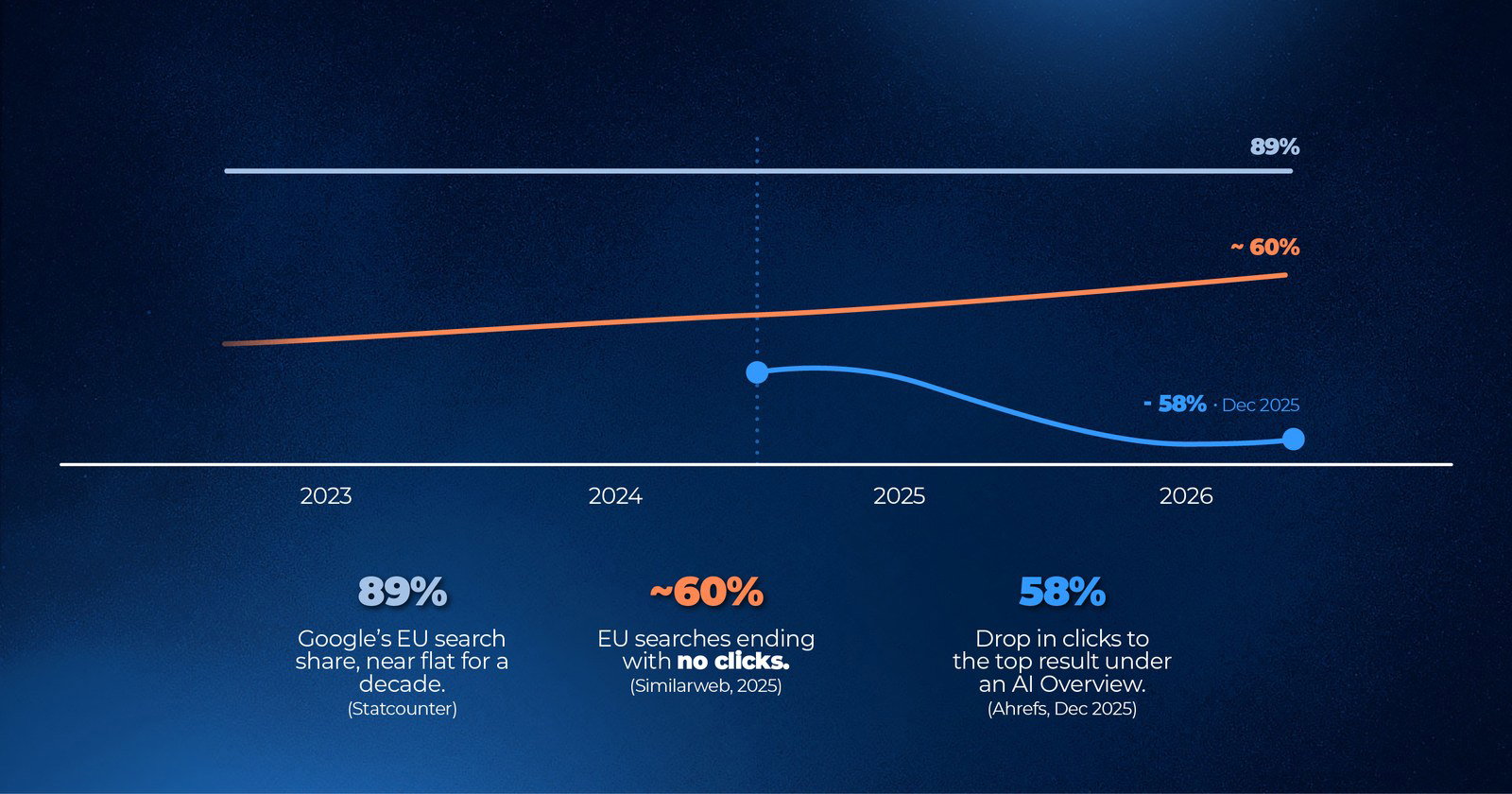
- 58%. When Google shows an AI Overview, click-through to the top organic result falls by 58%, according to Ahrefs’ December 2025 study of 300,000 keywords. Eight months earlier the same measurement was 34.5%. The trend is not slowing down.
- ~60%. Roughly six in ten Google searches in the EU now end with no click at all, per Similarweb’s 2025 zero-click analysis, rising above 65% on informational queries. The traffic is not moving to a competitor. It is evaporating on the results page.
- ~89%. Google’s share of European search, which has barely moved in a decade. This is the number everyone points to when they tell you nothing is really changing. It is also the most misleading one, and I will explain why.
- 2027. The year Google is legally required to start handing its search data to competitors. Not a prediction. A European Commission order.
Put those together and you get the argument I want to make: Google’s market share is stable while the thing that share was built on is quietly being taken apart. The click is draining away, and the moat that stopped anyone from competing is being opened by regulation. If you run locations for a living, that combination is not a threat. It is the best opening you have had in a decade.
Why nobody could beat Google
Start with why that 89% has been so immovable. It was never the search box. You can build a search box in a weekend. What you cannot build in a weekend, or a decade, or with a billion euros lying around, is what sits behind it: an index of most of the web, plus fifteen years of records of what real people clicked and were satisfied by. Every search sharpens it, which pulls in more searchers, which sharpens it again.
That loop is why a “European alternative” almost always turned out to be a nicer interface on Bing’s or Google’s results. Ecosia spent 16 years not running its own index, because building one was pointless when you could never catch up. That was the rational choice. It just stopped being the only one.
"The 89% is a rear-view mirror. The 58% drop in clicks is the windscreen. One tells you where search has been, the other tells you where it is going." Astghik Nikoghosyan, Growth Marketing Manager, PinMeTo
Two changes, and one of them is a law
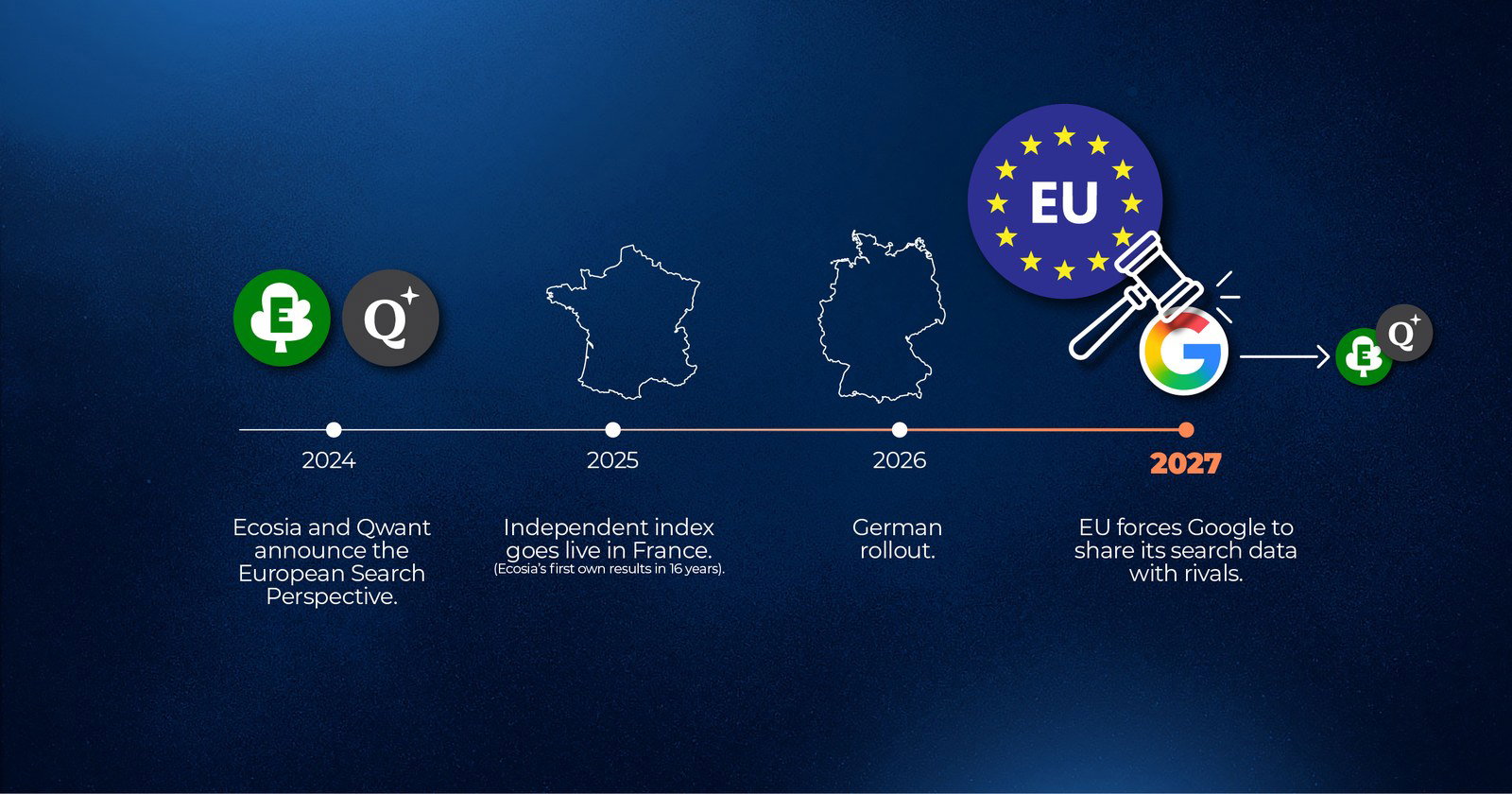
The law is draining the moat. In July 2026 the European Commission ordered Google to hand its search data to competitors from January 2027: rankings, queries, and click and view data, shared in anonymized form with rival engines and with AI chatbots that do search. Euronews reported that Android is being opened to rival assistants at the same time. The one asset a challenger could never acquire, Google now has to give away. Anonymized, with limits, but the wall is breached.
Someone finally built the thing to pour the data into. Ecosia and Qwant launched their own European index, the European Search Perspective, in August 2025. In Ecosia’s own words, it was the first time in its 16-year history it served results from an index it controls rather than reselling someone else’s. The ambition is not modest: the joint venture aimed to serve around 50% of French queries and a third of German queries from its own index by the end of 2025. Regulated access to Google’s signals only matters because there is now somewhere European to put them.
Together they do not produce one Google-killer. They produce the conditions for many small, specific ones: privacy-first engines, search baked into browsers, European AI assistants that can finally afford a real index. Fragmentation, not replacement.
Picture it from a customer’s phone
Here is the scene I keep coming back to. Someone in Frankfurt needs a supplier. They do not open Google and scroll ten blue links, because the zero-click data says most of them never did. They ask whatever assistant is in front of them, in their browser, on their phone, inside a European tool their company pays for, and it hands back three names with a sentence each.
You are one of those three or you do not exist. There is no page two, and “we rank fourth” means nothing. The thing choosing those three names is not reading your ad budget. It is reading your data: address, hours, services, in a shape it can parse without guessing. That is the whole game now.
The part I actually find exciting
For fifteen years, the reliable way a big, average competitor beat a smaller, sharper one was money. Outspend them on Google Ads, drown them out. That lever is losing its grip, and there is a number for that too.
When Perplexity shut down its advertising in early 2026, it did so while sitting on roughly $200 million in annual recurring revenue from subscriptions. An executive told the Financial Times the company is “in the accuracy business,” reasoning that paid placements would make users doubt every answer it gave. Read that as a marketer: a serious answer engine just decided the answer is not for sale, and had the revenue to mean it. The door marked “pay to be recommended” is being welded shut. The one marked “be the most trustworthy, most machine-readable source” is the only way in.
That rewards discipline over budget, and discipline is the one thing you can fully control.
"For once the expensive competitor does not win by default. The brand with the cleanest data does." Astghik Nikoghosyan, Growth Marketing Manager, PinMeTo
So what do you actually do
Not abandon Google. It is still ~89% of the market, and anyone telling you to walk away is selling you something. This is a hedge, and it is cheap relative to what it protects.
Do the thing almost nobody bothers to do: treat your location data like code, not copy. Every location page carrying real structured markup, with the address, hours, and coordinates written so a machine reads them without guessing. Push that same clean data to Bing and OpenStreetMap, because that is the plumbing feeding Ecosia, Qwant, and DuckDuckGo, and almost everyone syncs to Google and forgets the rest exists. Write for the model that summarizes you before a human clicks, which is the whole idea behind content AI actually cites and earning a spot in AI Overviews. And if France or Germany matter to you, write real German and French, not the output of a translate button, because the new index was built specifically to serve those markets and it notices. Our 2026 ranking-factors piece has the mechanical detail.
None of that is thrilling, which is the point. The thrilling-sounding work, chasing whatever AI ad format launched this month, is mostly a distraction. The dull structural work is the entire advantage.
Where I land
I will say the obvious out loud: this is the world PinMeTo was built for, so of course I like it. Take my company out of the picture and the conclusion does not move, because it rests on the numbers, not on my preference. Clicks to the top result are down 58% where AI answers appear. Around 60% of EU searches end without a click. And in 2027 the data that made Google unbeatable stops being Google’s alone. When search splinters and money buys less of the answer, accurate, structured, everywhere-consistent location data is worth more than it has ever been.
The Google monopoly is not dying because Google got worse. It is dying because Europe decided one company should not own the only door, and then built a second one and wrote a law to furnish it. The brands treating that as a quiet data cleanup right now, while everyone else argues about AI Overviews, will walk through every door that opens. The rest will spend 2027 working out exactly when they disappeared.
See if your location data is ready
Sources
- Ahrefs: AI Overviews reduce clicks by 58% (December 2025 study, 300,000 keywords); earlier 34.5% finding
- Similarweb / SparkToro on zero-click search: under a third of Google searches send a click; ~60% of EU searches end without one
- Statcounter: search engine market share, Europe: Google around 89%
- EU orders Google to share search data with rivals from 2027 (Search Engine Land); coverage from Euronews
- European Search Perspective; Ecosia’s index launch; TechCrunch on Staan and the French and German query targets
- Perplexity pulls ads, citing trust (Campaign)

Recommended Articles
What Meta's Muse AI Agent Means for Your Location Data
Meta's Muse is the fastest-downloaded AI agent yet, and it already trips over stale local data. What Muse, Overture Maps, and open POI data mean for multi-location brands.
Marcus Olsson
How to Create Local Content That AI Search Engines Actually Cite
Optimize local content for AI search engines. Learn what makes AI cite your pages, plus a practical content audit framework for multi-location brands.
Marcus Olsson
Local SEO Ranking Factors 2026: A Practical Guide for Multi-Location Brands
A 2026 guide to local SEO ranking factors: Google's relevance, distance, and prominence, plus AI Overviews, review recency, and multi-platform strategy.
Astghik NikoghosyanFrequently Asked Questions
Is Google really losing its search monopoly in Europe?
How much are AI Overviews actually cutting clicks?
What is the 2027 DMA data-sharing rule?
What should a multi-location brand do about it now?
Subscribe to Our Newsletter
Get local SEO tips, product updates, and marketing insights for multi-location brands delivered to your inbox.
Ready to boost your local visibility?
See how PinMeTo helps multi-location brands manage listings, reviews, and local SEO at scale.
Book a Demo