The New Rules of Google Ranking in 2026 (For Multi-Location Brands)
- Local SEO
- Multi-Location
- How-to Guides
- AI Search
Quick take
- Google's leadership has confirmed five 2026 ranking rules: low-value content is actively demoted, click quality is a ranking signal, AI Overviews favor depth, queries are 3× longer, and zero-click is the default.
- According to Liz Reid, Google is no longer just ignoring "slop", it is actively demoting it. Boilerplate location pages are the canonical example.
- Sundar Pichai (Cheeky Pint, April 2026): AI-mode and AI Overview queries are roughly 3× longer than classic keyword searches.
- Roughly 60% of classic Google searches end with no click, 83% with AI Overviews, and 93% inside AI Mode. Visibility now means being cited inside the answer.
- For multi-location brands, depth at scale beats volume: every location page needs genuinely local content, not a templated block.
In April 2026, Google’s CEO Sundar Pichai sat down for a long conversation with Stripe’s founder on the Cheeky Pint podcast and said the quiet part out loud: search is changing into something agentic, conversational, and far less click-driven than the version most brands have spent the last decade optimizing for. Around the same window, Google’s VP of Search, Liz Reid, gave two public talks (Bloomberg in April, the Wall Street Journal in October 2025) and published a blog post on the Google blog that, taken together, confirm a set of ranking rules a lot of teams are still ignoring.
If your brand has hundreds or thousands of locations, the implications are larger than they look. Boilerplate at scale used to be a shortcut. In 2026, it’s a liability. Here are the five things Google’s leadership has confirmed, with a multi-location lens on what each one means for you.
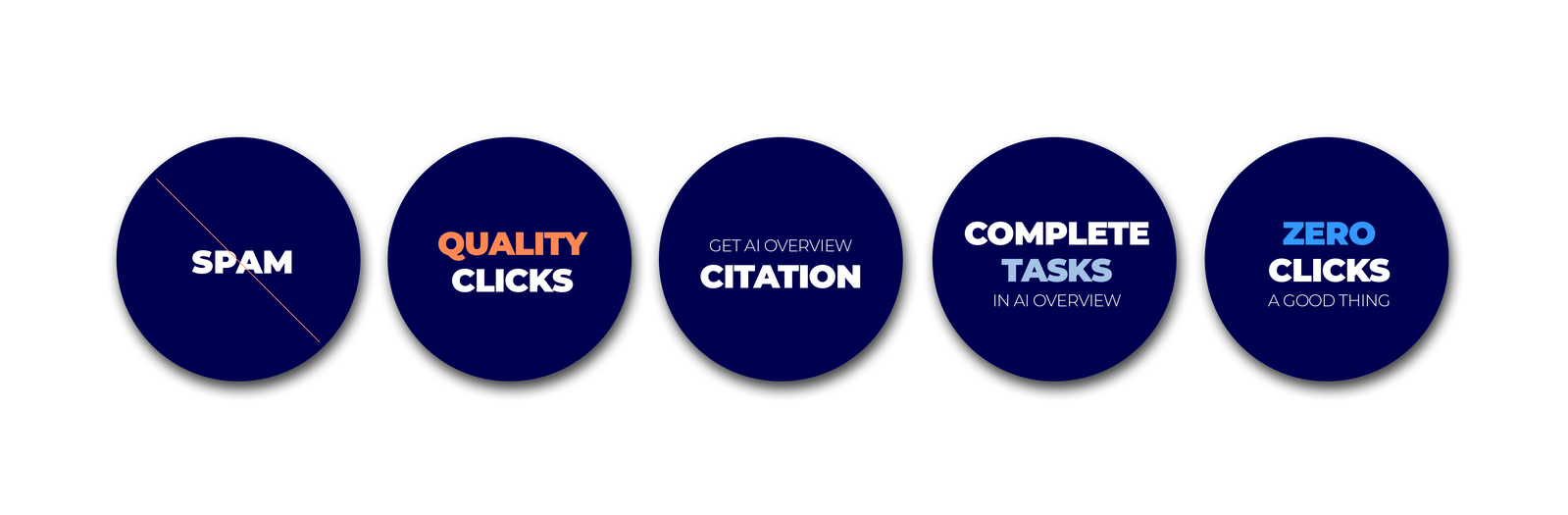
1. Low-value content is now actively demoted, not just ignored

"We're no longer just demoting spam. We're demoting low-value content."
Liz Reid
VP of Search, Google
Paraphrased from Bloomberg interview · April 2026
For years, Google’s stance on thin or low-quality content was, roughly, “we won’t reward it.” In April 2026, Liz Reid told Bloomberg the bar moved. Google is now actively demoting low-value content. She used the term “slop” to describe thin posts, shallow AI-generated filler, and pages that earn a quick click followed by a fast bounce. The rule isn’t about who or what wrote the page. It’s about whether the content delivers depth and resolves the user’s intent.
Why this matters for multi-location brands. Templated location pages are the canonical example of “looks fine, feels empty.” When 500 location pages share the same 800-word block of boilerplate, with only the city name and address swapped in, every one of them is a candidate for “slop.” Google can detect near-duplicate content at scale, and once a pattern of thinness is established for one location URL, the assessment generalizes.
What to do: audit each location page for what is genuinely local. Local team, local photos, local services, local opening hours with seasonal nuance, local FAQs that reflect the questions customers actually ask. The brands that win at scale don’t write 500 unique articles. They build a structured template that pulls in enough genuinely local detail per page that the result is unmistakably specific.
2. Click quality is a ranking signal, not just a metric
"Average click quality has increased, and we're actually sending slightly more quality clicks to websites than a year ago. By quality clicks, we mean those where users don't quickly click back."
Liz Reid
VP of Search, Google
Google blog · August 2025
Google now treats the speed and direction of post-click behavior as a ranking input. If a user clicks your result, lands on the page, and pogo-sticks back to the search results within seconds, Google reads that as a vote against your page for that query. Do this enough times across enough queries and the ranking erodes.
Why this matters for multi-location brands. Pogo-stick behavior aggregates across your brand. A few slow or thin location pages are not just a “those pages are weak” problem. They drag the brand’s overall trust signal, which then affects how your other pages are weighted. This is why operational hygiene at scale (site speed, render quality, the first 150 words of every location page) is no longer optional.
What to do: treat the first viewport of every location page as the most expensive piece of real estate you own. Lead with the strongest local signal (best-in-class service in the city, opening hours, distance from a landmark, reviews summary). Eliminate slow scripts and unoptimized images. Use the Core Web Vitals report in Search Console as a triage list, starting with the highest-traffic locations. Server response time matters here too. Brands running dozens of location pages on underpowered shared hosting often see the slow first-byte times that drag Core Web Vitals down, which is why many switch to VPS hosting once they’re managing pages at scale.
3. AI Overviews favor depth, not summary
"What we see on what people click on AI Overviews is content that's richer and deeper than surface-level AI-generated content. People don't want that."
Liz Reid
VP of Search, Google
Wall Street Journal podcast · October 2025
We covered the citation mechanics in how AI Overviews are changing local search. The Reid quote is the policy statement behind that mechanic. The pages that get cited inside AI Overviews are the ones that demonstrate real depth: original data, expert framing, structured answers, location-specific facts that a generic summary can’t manufacture.
Why this matters for multi-location brands. A 200-word location page can’t get cited as a source for “best Italian restaurant with a vegan menu in [neighborhood] open after 10pm.” A page with the actual answer to that question, structured, sourced, and visible in the first third of the page, can.
What to do: write each location page as if it has to win one specific long-tail question. Lead with the answer in the first 150 words. Back it with structured data (LocalBusiness schema, AggregateRating, Offer). Make the FAQ section answer the questions customers actually ask at that location, not a generic five-question template.
4. Queries are getting three times longer, and far more conversational

"A lot of what are just information-seeking queries will be agentic in search. You'll be completing tasks. You'll have many threads running."
Sundar Pichai
CEO, Google
Cheeky Pint podcast with Patrick Collison · April 2026
The shift is already visible. Google’s data shows AI-mode and AI Overview queries are roughly three times longer than classical keyword searches. People stop translating their need into “keywordese” and instead describe their full situation: family size, dietary constraints, budget, time of day, specific service.
Why this matters for multi-location brands. The query “dentist near me” is being replaced by “best pediatric dentist with Saturday hours and emergency capacity within 15 minutes of [neighborhood].” A short-keyword page can’t answer that. A page that anticipates the long question (with structured content covering specialty, hours, availability, location, services) can.
What to do: add a “questions we get asked” section to every location page that mirrors how customers actually search. Pull from your Google Business Profile Q&A, customer service tickets, and review content. If you operate at scale, PLACES AI surfaces these queries across locations so you can update once and propagate everywhere.
5. Zero-click is now the default state of search
This isn’t a temporary anomaly. It’s the new baseline. Search is becoming an answer engine, with the answer assembled from sources the user never visits.
Why this matters for multi-location brands. Visibility is no longer measured only by ranking on the SERP. It is measured by whether your locations are cited inside the AI answer. A brand that ranks #2 organically but never gets cited inside the AI Overview is, for most queries, invisible.
What to do: optimize for citation, not just ranking. That means NAP-consistent data across networks, schema markup on every location page, content that answers the long-tail question directly in the first viewport, and a steady cadence of fresh, location-specific reviews. If you’re new to listing management at scale, our step-by-step guide walks through the operational side.
The pattern: depth at scale beats volume
Read the five rules together and the pattern is obvious. Google’s leadership is describing a search experience that rewards:
- Depth over surface-level content
- Specificity over templated generics
- Resolution over teaser snippets that send users back to search
- Citability over rank position alone
For a single-location business, these rules are easy to follow because every page can be written individually. For a 500-location brand, the same rules require a different operating model. You need structured templates that surface genuinely local content at every page, real review and photo velocity per location, and a publishing process that prioritizes deep updates over high-volume thin output.
The good news is that none of this requires guessing what Google wants. Pichai and Reid have said it on the record. The question is whether your location strategy is structured to deliver on it.
Sources
- Sundar Pichai on the Cheeky Pint podcast with Patrick Collison (April 2026): on agentic search and longer queries.
- Liz Reid on Bloomberg (April 2026): on the active demotion of low-value content.
- Liz Reid, “How AI is improving search quality,” Google blog (August 2025): on click quality as a signal.
- Liz Reid on the Wall Street Journal podcast (October 2025): on what content gets cited inside AI Overviews.
Want to see how your locations are showing up across Google’s classic results, AI Overviews, and AI Mode? Book a demo and we’ll walk through a multi-location audit specific to your brand.

Recommended Articles
How to Create Local Content That AI Search Engines Actually Cite
Optimize local content for AI search engines. Learn what makes AI cite your pages, plus a practical content audit framework for multi-location brands.
Marcus Olsson
Local SEO Ranking Factors 2026: A Practical Guide for Multi-Location Brands
A 2026 guide to local SEO ranking factors: Google's relevance, distance, and prominence, plus AI Overviews, review recency, and multi-platform strategy.
Astghik Nikoghosyan
How to Make Your Multi-Location Website Agent-Ready in 2026
Make your multi-location website discoverable by AI agents. Practical guide to Content Signals, Markdown content negotiation, MCP Server Cards, and WebMCP for 2026.
Marcus OlssonFrequently Asked Questions
Does Google now actively demote AI-generated content?
How does click quality affect my rankings now?
How long are the queries that customers use in AI Overviews and AI Mode?
What percentage of searches now end without a click?
Should multi-location brands publish fewer, deeper pages instead of more pages?
Subscribe to Our Newsletter
Get local SEO tips, product updates, and marketing insights for multi-location brands delivered to your inbox.
Ready to boost your local visibility?
See how PinMeTo helps multi-location brands manage listings, reviews, and local SEO at scale.
Book a Demo