How AI Overviews Are Changing Local Search in 2026
- Local SEO
- Multi-Location
- Listings & Citations
- AI Search
Since late 2025, something fundamental has shifted in how people find local businesses. Google’s AI Overviews (the AI-generated summaries appearing above traditional search results) now show up on over 83% of all queries. That is not a test. That is the new default. And overlapping algorithm updates through February, March, and April 2026 have accelerated the transition from search engine to AI-first answer engine.
The scale of the impact is significant: Ahrefs’ study (February 2026) found that AI Overviews reduce organic clicks by 58%, nearly double the 34.5% reduction measured just eight months earlier. For a multi-location brand running 200 locations, that shift demands a strategic response.
There is some encouraging nuance, though. Seer Interactive’s analysis of 5.47 million queries shows that organic CTR on AI Overview queries rebounded from 1.3% in December 2025 to 2.4% in February 2026. That’s still well below pre-AI Overview levels, but it suggests the freefall may be stabilizing into a new baseline.
The real question is: Is your brand the one being cited in those overviews, or are you invisible in the results your customers actually see?
Brands winning this transition aren’t fighting the algorithm. They’re engineering their data and content to become the sources AI systems cite. And the framework for doing that is more predictable than you’d expect.
How AI Overviews Work for Local Queries
Before you can optimize for AI Overviews, you need to understand how they assemble answers, especially for the local search queries that drive foot traffic and reservations.
When someone searches “best Italian restaurants near me” or “emergency dentist in Austin,” Google’s AI system doesn’t pull from one source. It synthesizes information from multiple data streams:
Google Business Profile data. Your listing’s hours, address, phone number, and reviews become raw material for the overview. A well-maintained Google Business Profile isn’t just a landing page anymore; it’s a source document for AI generation.
Structured data (Schema markup). When you implement LocalBusiness schema, Event schema, or Offer schema correctly, you create machine-readable signals that AI systems prioritize. This isn’t new technology, but it has never been more important.
Authoritative web content. Pages that rank well for location-specific keywords (“best tacos in Denver,” “dermatologist in Portland”) get cited heavily in AI Overviews. The AI system uses rankings as a proxy for authority.
Topical expertise and review velocity. Brands with consistent, recent reviews and demonstrated topical authority (through content and user behavior) get weighted more heavily in citations.
First-mover advantage on new platforms. Brands that appear early in AI-indexed data and maintain consistent signals get cited more often as training data stabilizes.
Here’s what matters most: research on LLM positional bias shows that content appearing in the first third of a page receives disproportionate citation attention. One analysis of 1.2 million ChatGPT responses found that 44.2% of citations originated from the first 30% of source text, consistent with Stanford’s “Lost in the Middle” findings on how language models process long contexts. This isn’t arbitrary; AI systems weight early-appearing content higher because it’s usually where the most authoritative, summarized information lives. For local brands, this means your opening sentences (on your website, in your Google Business Profile description, and in your introductory content) are the most visible territory in AI-generated results.
The 5-Step Framework: Earning Citations in AI Overviews
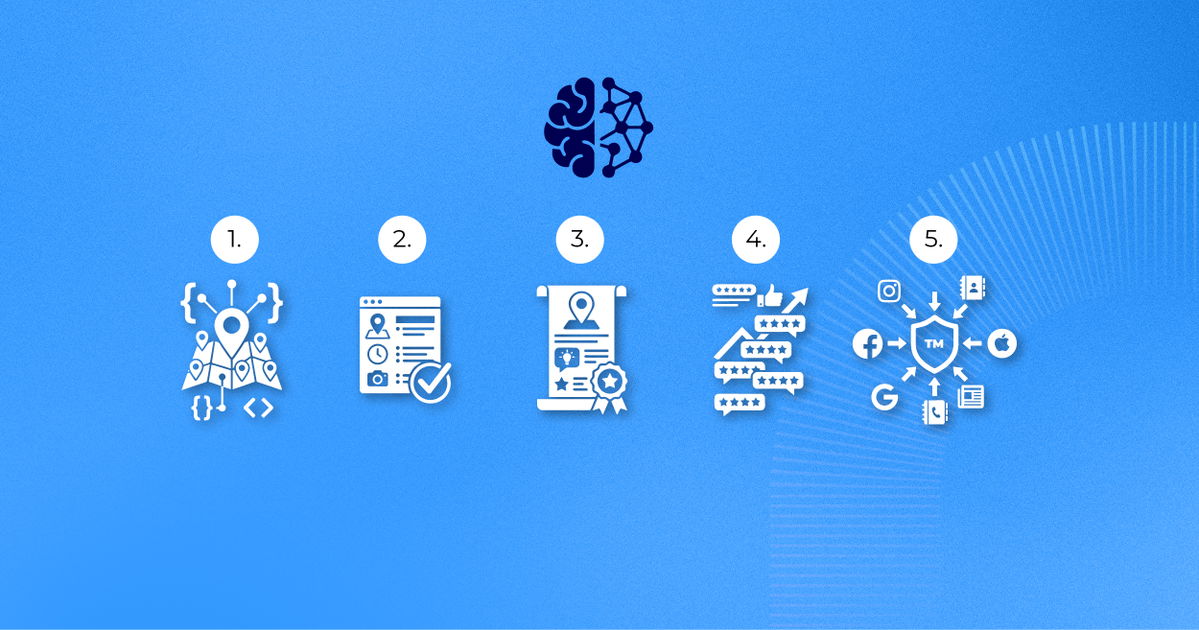
Multi-location brands can’t rely on luck or one-off optimization. You need a systematic approach that accounts for how AI systems actually consume and cite your data across dozens or hundreds of locations. Here’s the framework:
Step 1: Implement Structured Data Across All Locations
Structured data (Schema markup) is the clearest signal you can send to AI systems. It removes ambiguity and helps Google understand your business entity, location, hours, and offerings.
For multi-location brands, this means:
- LocalBusiness schema on every location page, including: name, address, phone number, geo-coordinates, opening hours, service area, and image URL
- Organization schema on your homepage to establish brand-level authority
- AggregateOffer schema if you offer services at varied price points across locations
- AggregateRating schema pulled from your review aggregation (ratings from Google Business Profile carry more weight than average ratings)
In practice: a 50-location fitness brand should have LocalBusiness schema on every location page and ensure that schema feeds into their Google Business Profile data. When AI systems see alignment between your website schema and your Google Business Profile data, trust increases. When they see conflicts, you lose citations.
The implementation check: run each location URL through Google’s Rich Results Test. If schema isn’t passing validation, AI systems are working with degraded data about you.
Step 2: Maximize Google Business Profile Completeness and Accuracy
Your Google Business Profile listing is no longer just a business directory entry. It’s a primary source document for AI generation. Completeness matters more than it ever has.
This means:
- Complete all profile fields: business category, description, phone, website, hours (including holiday hours), service areas, and attributes
- Add product and service categories specific to each location (if you operate multi-concept locations, this varies)
- Post consistently: regular posts on Google Business Profile signal active management and provide fresh content for AI systems to reference
- Encourage review velocity: more recent reviews matter more than old ones for AI citations. A location with 12 reviews posted in the last 30 days gets cited more often than one with 200 reviews from 2024
- Include location-specific photos and videos: AI systems weight visual content, especially user-generated reviews with images
NAP consistency (Name, Address, Phone) remains critical. Inconsistencies across your website, Google Business Profile, and other directories are red flags to AI systems. For multi-location brands, this is a data governance issue; set it up once, audit it quarterly. For the latest Google requirements, review our Google Business Profile guidelines for 2025.
Step 3: Create Location-Specific Content That Leads with Authority
Remember: research on LLM citation patterns shows that 44.2% of citations come from the first 30% of text. This changes how you should structure location pages.
Instead of:
“Welcome to our Springfield location. We’ve been serving the community since 2015. We’re excited to offer a wide range of services…”
Lead with:
“Best Italian restaurant in Springfield, serving authentic Tuscan cuisine, house-made pasta, and wood-fired pizzas since 2015. Award-winning wine list with 300+ selections.”
The difference is subtle but significant. The second version is immediately authority-signaling. It answers the likely query intent (“best Italian restaurant in Springfield”) in your opening statement, which is exactly where AI systems look for citation material.
For multi-location brands: create a template that front-loads authority claims and location-specific differentiation, then customize each location page. You’re not creating 200 unique pieces of content; you’re creating 200 variations on a structured template that leads with the signal AI systems prioritize.
Step 4: Build Review Velocity and Authenticity Signals
AI systems increasingly distinguish between old, stagnant review profiles and actively managed ones. Review velocity (the frequency of new reviews) is now a citation signal.
This means:
- Target 2-4 new reviews per location per month (achievable through systematic email requests, QR codes, and SMS if you have permission)
- Respond to all reviews within 48 hours, especially for multi-location brands (response rate and speed are citation signals)
- Encourage detailed, specific reviews over generic ones. “Great service!” gets cited less often than “The owner personally checked on our table three times and the pasta was perfectly al dente.”
- Diversify review sources: reviews from Google, industry-specific platforms (Healthgrades for healthcare, OpenTable for restaurants), and other relevant directories all carry weight
In practice: multi-location brands should have a centralized review management system that distributes review requests location by location, bundles responses for efficiency, and flags low-velocity locations for targeted outreach.
Step 5: Establish Brand Authority Signals Beyond Your Website
Brands that get cited heavily in AI Overviews often have authority signals beyond their owned properties. This includes:
- Earned media: press mentions, news coverage, and industry publications. When a business is mentioned in a credible news source, AI systems treat it as third-party validation
- Expert credentials: team member bylines, speaking engagements, and professional certifications. A location manager who’s written published guides or speaks at industry events strengthens the location’s authority profile
- Citation consistency: appearing consistently across multiple platforms (industry directories, franchisee networks, association listings) tells AI systems this is a stable, legitimate entity
- Industry awards and recognition: these get weighted in citation decisions, especially for competitive categories
For multi-location brands: create a centralized PR and content strategy that can be localized. Your head office might earn a press mention that benefits all locations through brand authority lift. Your individual locations can earn local press coverage that boosts their own citation potential.
The Reality: Not All Locations Will Win Equally
One critical insight: AI Overviews don’t treat all locations the same. Competitive categories (restaurants, healthcare, fitness) see more AI citation variation than utility services. Some locations will see AI Overview citations improve their visibility significantly. Others in saturated markets may see modest traffic redirection.
The goal isn’t to reverse AI Overviews; that’s not happening. The goal is to ensure you’re cited when they appear, and to build a system that captures traffic through multiple channels: direct, paid, organic, and AI-generated.
Brands that win this transition have two things in common:
-
Systematic data integrity. They treat multi-location data as a product, not an afterthought. Updates, schema, Google Business Profile content, and review management are structured, not chaotic.
-
Authority-first thinking. They optimize for being cited, not for driving clicks directly. This flips the order of operations: first establish yourself as a trustworthy source, then clicks follow.
For the broader strategy behind this shift, see our GEO framework for multi-location brands.
Quick Audit: Is Your Brand Ready for AI Overviews?
Ask yourself:
- Do all location URLs have valid LocalBusiness schema?
- Is your Google Business Profile 95%+ complete across all locations?
- Do your location pages lead with authority (keywords, claims, awards) in the first 150 words?
- Are you generating 2+ new reviews per location per month?
- Do you have a system for responding to reviews within 48 hours?
- Is your NAP consistent across your website, Google Business Profile, and third-party directories?
- Are you tracking which locations appear in AI Overviews for relevant keywords?
If you’re checking fewer than 5 boxes, AI Overviews are likely redirecting traffic away from you. If you’re hitting all 7, you’re positioned to benefit as AI systems continue to evolve.
Scaling AI Overview Optimization Across Hundreds of Locations
Everything in the framework above works for a single location. The real challenge for multi-location brands is doing it at scale, consistently, across 50, 200, or 1,000+ locations.
That’s where centralized location marketing technology becomes essential. Platforms like PinMeTo’s PLACES AI help multi-location brands manage structured data, Google Business Profile completeness, review velocity, and NAP consistency from a single starting point, turning what would be a chaotic manual process into a repeatable system. When your data is accurate, complete, and trusted across every location, AI systems have stronger signals to cite.
Sources and References
-
Ahrefs, “AI Overviews Reduce Clicks by 58%” (February 2026). Analysis of 300,000 keywords showing that AI Overviews correlate with a 58% lower average click-through rate for top-ranking pages, based on December 2025 data.
-
Seer Interactive, “AIO Impact on Google CTR: 2026 Update” (2026). Study of 5.47 million queries and 2.43 billion impressions showing organic CTR rebounded from 1.3% to 2.4% on AI Overview queries in early 2026.
-
Victorino Group, “LLM Citation Attention Patterns”. Analysis of 1.2 million ChatGPT responses finding that 44.2% of citations originated from content appearing in the first 30% of source text.
-
Liu et al., “Lost in the Middle: How Language Models Use Long Contexts”. Transactions of the Association for Computational Linguistics (TACL), 2024. Foundational research on how language models exhibit positional bias when processing long contexts.
-
Google Business Profile Help Center. Official documentation on managing business information for local search and AI systems.
Looking for ways to strengthen your local visibility across AI-powered search? Book a demo to see how PLACES AI helps multi-location brands stay competitive on every search surface.

Daniel Melkersson
CRO & Co-founder
Daniel is the CRO and Co-founder of PinMeTo. He writes about location marketing strategy, the future of local search, and how multi-location brands can leverage technology to drive foot traffic and customer engagement.

Astghik Nikoghosyan
Growth Marketing Manager
Astghik writes about SEO, AI Optimization (AIO), and local growth strategies for multi-location brands, covering everything from managing listings to building stronger visibility in both traditional search and AI-powered discovery.
Recommended Articles
How to Win AI Search Before Your Competitors Even Notice: AI SEO Hacks
Lean AI SEO hacks to optimize your brand for AI-driven search results with clear structure, verified local listings, and strong trust signals.
Lily Adamyan
What Meta's Muse AI Agent Means for Your Location Data
Meta's Muse is the fastest-downloaded AI agent yet, and it already trips over stale local data. What Muse, Overture Maps, and open POI data mean for multi-location brands.
Marcus Olsson
How to Create Local Content That AI Search Engines Actually Cite
Optimize local content for AI search engines. Learn what makes AI cite your pages, plus a practical content audit framework for multi-location brands.
Marcus OlssonFrequently Asked Questions
Will AI Overviews completely eliminate organic click-through?
Do I need to change my SEO strategy completely?
How long does it take to see results from these changes?
What if I have 200+ locations? Can I really do this at scale?
Are there categories where AI Overviews matter less?
Subscribe to Our Newsletter
Get local SEO tips, product updates, and marketing insights for multi-location brands delivered to your inbox.
Ready to boost your local visibility?
See how PinMeTo helps multi-location brands manage listings, reviews, and local SEO at scale.
Book a Demo