GDPR-Compliant Local SEO Software for European Brands
- Local SEO
- Multi-Location
- How-to Guides

Quick take
- GDPR applies to any brand handling EU residents' data, not just EU-headquartered businesses.
- Most US-based local SEO platforms route European data through US infrastructure, creating compliance exposure you may not be aware of.
- ISO 27001 certification is the practical benchmark for a genuinely GDPR-ready vendor.
- A Data Processing Agreement (DPA) is legally required before your vendor processes personal data on your behalf, and compliant vendors provide one before contract signing.
- EU data residency is the most defensible choice. US storage with Standard Contractual Clauses is technically viable but faces growing regulatory scrutiny.
GDPR-compliant local SEO software stores European data in EU data centers, provides a Data Processing Agreement before contract signing, holds ISO 27001 certification, and enables your customers’ right to erasure on request. Most US-based local listing platforms do not meet all four requirements by default. If your brand manages locations across Europe, that gap is your compliance liability.
Your brand operates across Europe. Your local marketing strategy depends on managing business listings, location data, and customer information across dozens or hundreds of locations. Then you review your local SEO platform’s terms of service and discover something important: your data is processed on US servers, handled by a US company, and subject to US law.
This isn’t unusual. Most local listing management platforms are US-headquartered and route European business data through American infrastructure. Yet GDPR compliance isn’t optional for European brands. The penalty for non-compliance reaches up to €20 million or 4% of annual global revenue, whichever is higher.
The question is: how do you evaluate a local SEO platform for genuine GDPR compliance?
What Does GDPR Compliance Actually Require From a Local SEO Platform?
GDPR compliance for a local SEO platform means holding a valid ISO 27001 certification, storing European data in EU data centers, providing a signed Data Processing Agreement before you start, and enabling your customers’ right to erasure on request. GDPR isn’t a single feature to check off. It is a framework of requirements that reshape how software companies handle European data.
Data Processing Agreements (DPAs)
When you use a local SEO platform, that platform processes personal data on your behalf. Under GDPR Article 28, you (the brand) are the “data controller” and your vendor is a “data processor.” This relationship legally requires a written Data Processing Agreement specifying:
- What data is processed and for what purposes
- How long data is stored and where
- Who can access it and under what conditions
- What happens if there is a breach
- Your right to audit the processor
Many vendors offer DPAs as an afterthought, buried in fine print or available only on request. GDPR-ready vendors make DPAs available transparently before you sign, with Standard Contractual Clauses for EU data transfers already included.
Data Residency and Storage Location
European data protection authorities increasingly expect personal data to be stored within the EU by default. For local SEO platforms, this matters because the platform stores customer names and locations linked to business listings, review responses and customer interactions, user account data, and campaign performance data tied to specific locations.
If this data transits US infrastructure, it is theoretically accessible to US law enforcement under laws like the Foreign Intelligence Surveillance Act (FISA). For brands handling sensitive data in financial services, healthcare, or insurance, the requirement for EU data residency is often non-negotiable in vendor contracts.
Consent, Transparency, and Right to Erasure
Your customers have the right to request deletion of their personal data. Your platform must enable quick deletion of customer records, remove associated data from all systems, and provide audit trails confirming what was deleted. Compliant vendors build these capabilities into the product itself, not as a support ticket. Businesses evaluating privacy compliance platforms often compare OneTrust alternatives to find solutions that better match their consent management, data privacy, and regulatory compliance requirements.
Sub-processor Management
Your local SEO vendor almost certainly uses third-party services: map APIs, analytics tools, hosting providers. GDPR requires that you know who these sub-processors are and that your vendor maintains compliant agreements with each of them. Compliant vendors maintain and regularly update a public list of all sub-processors, and allow you to object to new additions before they take effect.
Where Your Business Data Actually Lives: The Hidden Risk in US-Based Platforms

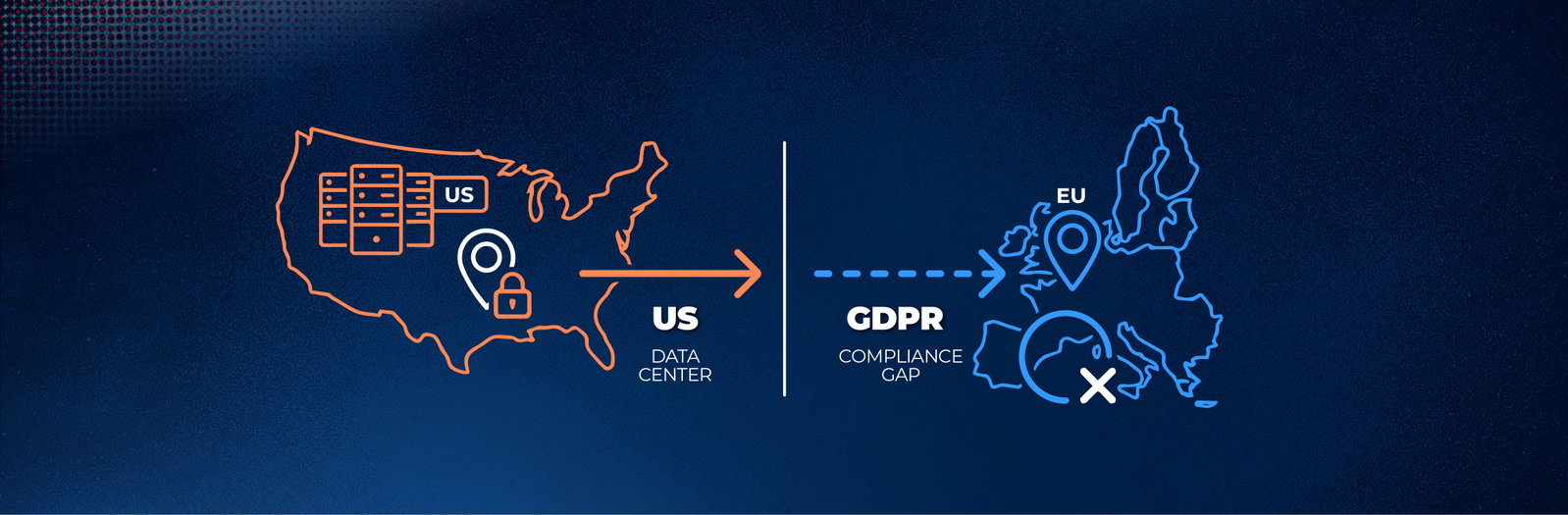
When you use a US-headquartered local SEO platform, your European business data typically travels to US data centers, where it becomes theoretically accessible to US law enforcement under the Foreign Intelligence Surveillance Act, regardless of any contractual assurances your vendor provides.
Here is the typical data flow for a US-based platform:
- Your location data, customer information, and listings are uploaded to the platform’s servers.
- Those servers are in US data centers (often AWS, Google Cloud, or Azure US regions).
- Your data is processed, syndicated, and analyzed using US-based infrastructure.
- US law enforcement can request access to that data without notifying you, because it is stored in the US.
The European Court of Justice has twice invalidated data transfer mechanisms between the EU and US, citing US government surveillance programs. The current Data Privacy Framework, adopted in 2023, provides some protection but is narrower than many vendors claim and faces ongoing legal challenges.
For location data specifically, the risk is compounded. Your business locations, opening hours, and customer visit patterns constitute sensitive location information. Combined with review data and customer records, this creates a detailed picture of your operations across every market you serve.
Why ISO 27001 Is the Practical Benchmark for GDPR-Ready Vendors
ISO 27001 is an international standard for information security management that has become the practical benchmark for enterprise GDPR compliance, because GDPR Article 32 requires “appropriate technical and organizational measures” to protect personal data, and ISO 27001 provides a standardized, independently audited framework for precisely those measures.
ISO 27001 certification requires organizations to conduct documented risk assessments, implement access controls and encryption, monitor for security incidents, train staff on data protection, and pass annual external audits. It does not guarantee GDPR compliance on its own, but it demonstrates that a vendor has built the security infrastructure GDPR requires. Selecting a platform with transparent incident management pricing ensures you can scale these security operations effectively as your team grows.
For European procurement teams, ISO 27001 certification is often a non-negotiable requirement, particularly in regulated industries. When your own compliance auditors review your vendor stack, ISO 27001 is the first certificate they look for.
The Compliance Checklist: How to Evaluate a Local SEO Vendor
A GDPR-compliant local SEO vendor must meet requirements across six areas: data residency, certifications, Data Processing Agreement quality, erasure and access rights, transparency and consent support, and sub-processor management. Use this checklist when evaluating any platform.
Data Residency and Storage
Certifications and Audit Rights
Data Processing Agreement
Right to Erasure and Data Access
Transparency and Sub-processor Management
Why It Matters: GDPR Enforcement Against Digital Platforms Is Accelerating
European data protection authorities issued hundreds of enforcement actions in 2023 and 2024, with penalties reaching €1.2 billion in a single case. As enforcement data from the GDPR tracker shows, fines are no longer reserved for headline cases. Mid-market platforms and their enterprise clients have received compliance notices across multiple EU jurisdictions.
Notable 2023 to 2024 enforcement actions:
- Meta platforms: €1.2 billion fine for non-compliant data transfers to the US
- Google: Multiple enforcement actions from French and Irish regulators for analytics and consent practices
- TikTok: Warnings and investigations across European markets for data handling
Your local SEO vendor is unlikely to be in regulatory crosshairs directly. But if they are processing European personal data without compliant measures, and you are the data controller, you bear liability for that non-compliance. The vendor’s fine and your fine are separate proceedings.
What a Genuinely GDPR-Compliant Platform Looks Like in Practice
A genuinely GDPR-compliant local SEO platform stores European data in EU regions by default, holds current ISO 27001 certification, makes its Data Processing Agreement available before contract signing, and provides audit trails so you can prove compliance to regulators if asked.
In practice, that means:
- EU data storage by default, often in multiple European regions for resilience
- Current ISO 27001 certification, renewed within the past three years and available on request
- Transparent, accessible DPAs, provided before purchase with Standard Contractual Clauses included
- Encryption in transit and at rest, using industry-standard TLS 1.3 and AES-256
- User rights enabled by default: your customers can access, correct, and delete their data without requiring custom engineering work on your side
- A public sub-processor list, updated regularly, with notification of changes before they take effect
- Breach notification within 24 to 48 hours, faster than GDPR’s 72-hour requirement
- Audit trails and access logging, providing a record for regulatory inquiries
These features are especially important for brands in regulated industries. Financial services, healthcare, and insurance organizations operating across Europe increasingly mandate this baseline in all vendor contracts.
Five Questions to Ask Any Local SEO Vendor About Data Compliance
Before signing any contract with a local SEO platform, these five questions reveal whether the vendor’s compliance posture is substantive or primarily marketing language.
“Where do you store European data, and can you prove it?”
Compliant vendors name the region (Frankfurt, Amsterdam, Ireland) and provide documentation. Vague answers like “we store data securely” or “we use AWS” are not sufficient. AWS spans multiple continents; that is not a data residency commitment.
“Can you provide your ISO 27001 certificate and latest SOC 2 Type II report?”
This should be a straightforward yes. If a vendor hesitates or requires a formal NDA before sharing basic certification documents, that signals they are not prepared for enterprise European clients.
“What happens to my data when our contract ends?”
Compliant vendors outline a clear deletion timeline (30 days is standard) and explain how archived backups are handled. They also confirm what data they retain for legal compliance and how long.
“Can you provide a DPA that includes Standard Contractual Clauses for EU data transfers?”
Any vendor handling European data should have this pre-drafted. If they say they will need to involve legal counsel for a standard DPA, that is a sign they are not equipped for European enterprise.
“Who are your sub-processors, and can I review the agreements?”
Compliant vendors maintain a public list and update it regularly. They allow objection to new sub-processors and provide evidence of sub-processor compliance agreements on request.
As Google Business Profile and other local search platforms evolve in 2026, the volume of personal data flowing through local SEO tools continues to grow. Choosing a platform with genuine compliance baked in from the start protects your brand, your customers, and your ability to operate confidently across European markets.
Looking for a local listing management platform built for European compliance from the ground up? PinMeTo is hosted in Europe, holds ISO 27001 certification, and provides a full GDPR compliance package including a DPA before contract signing.

Recommended Articles

How to Create Local Content That AI Search Engines Actually Cite
Optimize local content for AI search engines. Learn what makes AI cite your pages, plus a practical content audit framework for multi-location brands.
Marcus Olsson
Local SEO Ranking Factors 2026: A Practical Guide for Multi-Location Brands
A 2026 guide to local SEO ranking factors: Google's relevance, distance, and prominence, plus AI Overviews, review recency, and multi-platform strategy.
Astghik Nikoghosyan
How to Respond to Google Reviews at Scale Without Sounding Like a Robot
Manage review responses across dozens of locations without losing authenticity. Templates, timing, and a workflow for enterprise-scale review management.
Daniel MelkerssonFrequently Asked Questions
Does my brand need to be EU-based for GDPR to apply?
If a vendor says they are GDPR compliant, does that mean I am compliant too?
Is Standard Contractual Clauses the only way to transfer data from Europe to the US?
What is the difference between GDPR compliance and data privacy?
Should I insist on EU-only data storage, or is US storage with SCCs acceptable?
Subscribe to Our Newsletter
Get local SEO tips, product updates, and marketing insights for multi-location brands delivered to your inbox.
Ready to boost your local visibility?
See how PinMeTo helps multi-location brands manage listings, reviews, and local SEO at scale.
Book a Demo