What Is NAP Consistency? The Local SEO Fundamental Every Brand Needs to Get Right
- Local SEO
- Multi-Location
- Listings & Citations
- How-to Guides
Quick take
- Citation signals including NAP consistency account for approximately 11% of local pack ranking factors, according to Moz's Local Search Ranking Factors report.
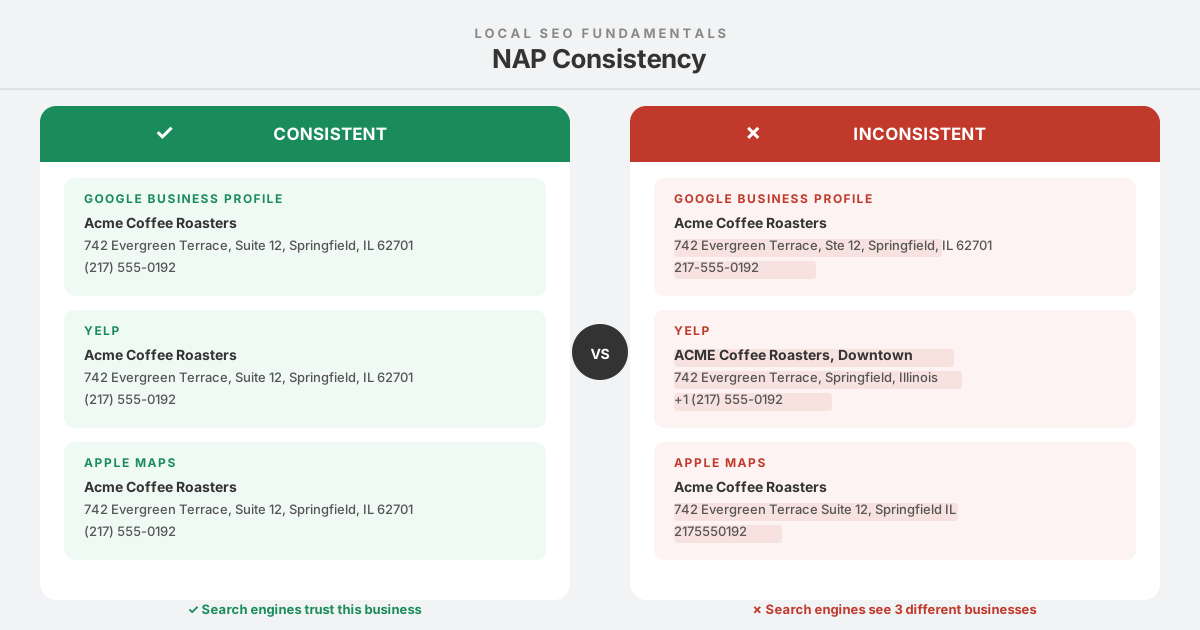
- Small differences like "Suite 200" vs "Ste 200" or "(206) 555-1234" vs "2065551234" are enough to make search engines treat your listings as different businesses.
- AI systems and generative engines are especially sensitive to NAP conflicts — they require corroboration across multiple sources before surfacing a business in results.
- Multi-location brands with 50+ locations need a centralized listing platform to maintain accurate NAP across 100+ directories simultaneously without manual work.
What Is NAP Consistency?
NAP consistency means your business’s Name, Address, and Phone number are identical across every online location where you appear: Google Business Profile, Apple Maps, Yelp, industry directories, your website, social media, and anywhere else.
That’s it. Simple concept. Massive impact.
When your NAP information matches perfectly across all platforms, search engines and AI systems treat your business as trustworthy and authoritative. When it doesn’t, when you’ve abbreviated your name on one platform, listed a suite number inconsistently on another, or formatted your phone number differently everywhere, search engines question whether you’re even the same business.
The real question is: How many customers are looking for you and not finding you because your information is fragmented?
Why NAP Consistency Matters to Search Engines
Search engines don’t just read one listing and move on. They crawl hundreds of thousands of business listings across the internet. They compare your NAP data across sources. If those sources align, you signal consistency and legitimacy. If they conflict, you signal either sloppiness or fraud.
Google’s algorithm uses NAP consistency as a trust signal: one of the core factors that determines whether your local search rankings go up or down. According to Moz’s Local Search Ranking Factors report, citation signals (including NAP consistency) account for approximately 11% of local pack ranking factors. The same principle applies to AI-powered search systems and generative engines that now power local discovery: they rely on data corroboration across sources to build confidence in business information.
Here’s the practical impact:
Consistency = Higher local rankings. When your NAP data is unified, search engines confidently connect all your listings back to your actual business. You get credit for every mention across every platform. Your rankings compound across the web.
Inconsistency = Missed opportunity. When search engines see conflicting information, they struggle to know which version is correct. They may deprioritize your listings, and you miss ranking potential you’re otherwise earning. Users searching for your business by phone number, address, or exact name may not find you on their first try, even though your business exists in their search results elsewhere.
AI systems and generative engines are even more sensitive to NAP inconsistency. These systems rely on corroboration: multiple sources confirming the same information, to include your business in results. Conflicting NAP data creates doubt. Matching NAP data creates confidence. For a deeper look at how this connects to broader local strategy, see our GEO framework for multi-location brands.
Common NAP Inconsistencies That Hurt Your Rankings
Most businesses don’t intentionally create NAP inconsistencies. They happen slowly, across teams, over time. A contractor updates their Google Business Profile but forgets Yelp. A team member abbreviates the company name on a new directory listing. Your office moves, but one listing never gets updated.
Here are the most common culprits:
Name Variations
- Legal name vs. branded name. You’re registered as “ABC Corporation” but operate as “ABC.” You list both versions across different platforms.
- Abbreviations. You abbreviate “Street” as “St.” on Google but spell it out on Yelp.
- Ampersands. Your name contains ”&” on one listing and “and” on another.
- Location descriptors. You add location identifiers (“ABC - Downtown Seattle”) on some listings but not others.
Address Inconsistencies
- Suite/unit numbers. Listed as “Suite 200” on Google, “Ste 200” on Yelp, and “200” on your directory listings.
- Street abbreviations. “Road” vs. “Rd,” “Avenue” vs. “Ave.”
- Punctuation. Periods after abbreviations on some platforms, missing on others.
- ZIP code variations. A 5-digit ZIP on some listings, 5+4 on others.
- State abbreviations. “California” spelled out on one listing, “CA” on another.
Phone Number Formatting
- Parentheses: (206) 555-1234 vs. 206-555-1234
- Spacing: 206 555 1234 vs. 2065551234
- Extension variation: Listed with an extension on some platforms, without on others.
- Country code: “+1 206 555 1234” vs. “206 555 1234”
These small variations seem trivial to humans. To search engines, they look like different businesses.
The NAP Audit Checklist
You can’t fix what you don’t know about. Here’s how to audit your NAP consistency:
1. List every platform where your business appears
- Google Business Profile
- Apple Maps
- Yelp
- Industry-specific directories (Angie’s List, TripAdvisor, etc.)
- Your website (contact page, footer, about page)
- Social media profiles (Facebook, Instagram, LinkedIn)
- Directory aggregators (Whitepages, YellowPages)
- Any directory or listing service you’ve ever claimed
2. Document your official NAP data
- Write down your exact legal business name (as it appears in business registration)
- Your complete street address (with suite number, if applicable)
- Your primary phone number (in your preferred format)
3. Check each platform
- Visit each listing and record exactly how your name, address, and phone appear
- Copy-paste the text directly, don’t paraphrase
4. Compare for inconsistencies
- Run all versions side by side
- Mark every difference, no matter how small
- Flag abbreviations, formatting, spacing, punctuation differences
5. Standardize across all platforms
- Update every listing to match your official NAP
- Some platforms may auto-format your address (Google does this): that’s fine as long as they resolve to the same physical location
- Update your website and social profiles first, then work through each directory one at a time
Save your standardized NAP in a document and reference it as you make updates. Consistency is easier when you’re copying from a single source of truth.
NAP Consistency for Multi-Location Brands
If you manage multiple locations, NAP consistency becomes even more critical and more complex. The same principle applies to each location: your Name must be consistent across all listings for that location, your Address must match perfectly, and your Phone number must be standardized. But you also need consistency across locations.
Brands that win at multi-location SEO use the same naming convention, address formatting, and phone number structure for every location. If Location A is listed as “ABC Downtown” on Google, Location B should be “ABC Midtown,” not “ABC - Midtown” or “Downtown ABC” on one platform.
If you’re running 50+ locations, manual NAP audits become a significant bottleneck. You need a system that maintains your standardized NAP across every platform simultaneously: Google Business Profile, Apple Maps, Yelp, industry directories, and beyond.
That’s where local listing management tools become essential. Instead of manually updating each listing when you move a location or need to correct a phone number, a centralized platform pushes that NAP data across every directory at once. You maintain one source of truth, and the tool handles synchronization.
Platforms like PinMeTo’s local listing management let you define your standardized NAP once and distribute it across your entire location portfolio. When a location moves or a new one opens, you update once and it propagates everywhere. For an operational walkthrough of how this works at scale, see our guide on managing business listings at scale.
Moving Forward
NAP consistency is one of those fundamentals that doesn’t generate excitement or headlines. It’s not a trendy new algorithm or a hot feature. But it compounds. Every listing you keep consistent with the others is another signal to search engines that you’re trustworthy. Every inconsistency is a small erosion of your visibility.
In practice, brands that audit their NAP and fix inconsistencies see measurable improvements in local rankings within weeks. You’re not just fixing a data problem: you’re unlocking visibility that was already there but hidden by confusion.
Start with the audit checklist above. Find your inconsistencies. Then systematically fix them.

Recommended Articles

How to Manage Business Listings at Scale: A Step-by-Step Guide
Managing hundreds of business listings? Follow this 5-step workflow to keep location data accurate across 100+ networks, from audit to optimization.
Björn Handell
What Is Local Listing Management? A 2026 Guide
Local listing management keeps your business details accurate across Google, Apple Maps, and directories. Learn what it is, why it matters, and how to do it at scale.
Björn Handell
How to Win AI Search Before Your Competitors Even Notice: AI SEO Hacks
Lean AI SEO hacks to optimize your brand for AI-driven search results with clear structure, verified local listings, and strong trust signals.
Lily AdamyanFrequently Asked Questions
Does NAP consistency matter for national or non-local brands?
What if my business moved? How do I handle the old address?
Are abbreviations okay if they're standardized?
How often should I audit my NAP?
Does NAP consistency affect rankings on Google Maps specifically?
Subscribe to Our Newsletter
Get local SEO tips, product updates, and marketing insights for multi-location brands delivered to your inbox.
Ready to boost your local visibility?
See how PinMeTo helps multi-location brands manage listings, reviews, and local SEO at scale.
Book a Demo