Places AI Turns your location data into the next winning action
 Ehsan Mousavi
Places AI is the single starting point for everything PinMeTo knows about your locations. It reads the data you already manage, works out where you are losing customers between a search and a visit, and turns that into a short, ranked list of actions, each with the gain it would bring and the colleague who should own it.
The outcome is more locations found, chosen and visited, with less of your week spent deciding what to do. Most multi-location brands are not short of numbers. Places AI is built to answer the question the numbers never did: of our six hundred locations, which one is costing us customers this week, and what do we do about it?
At a glance
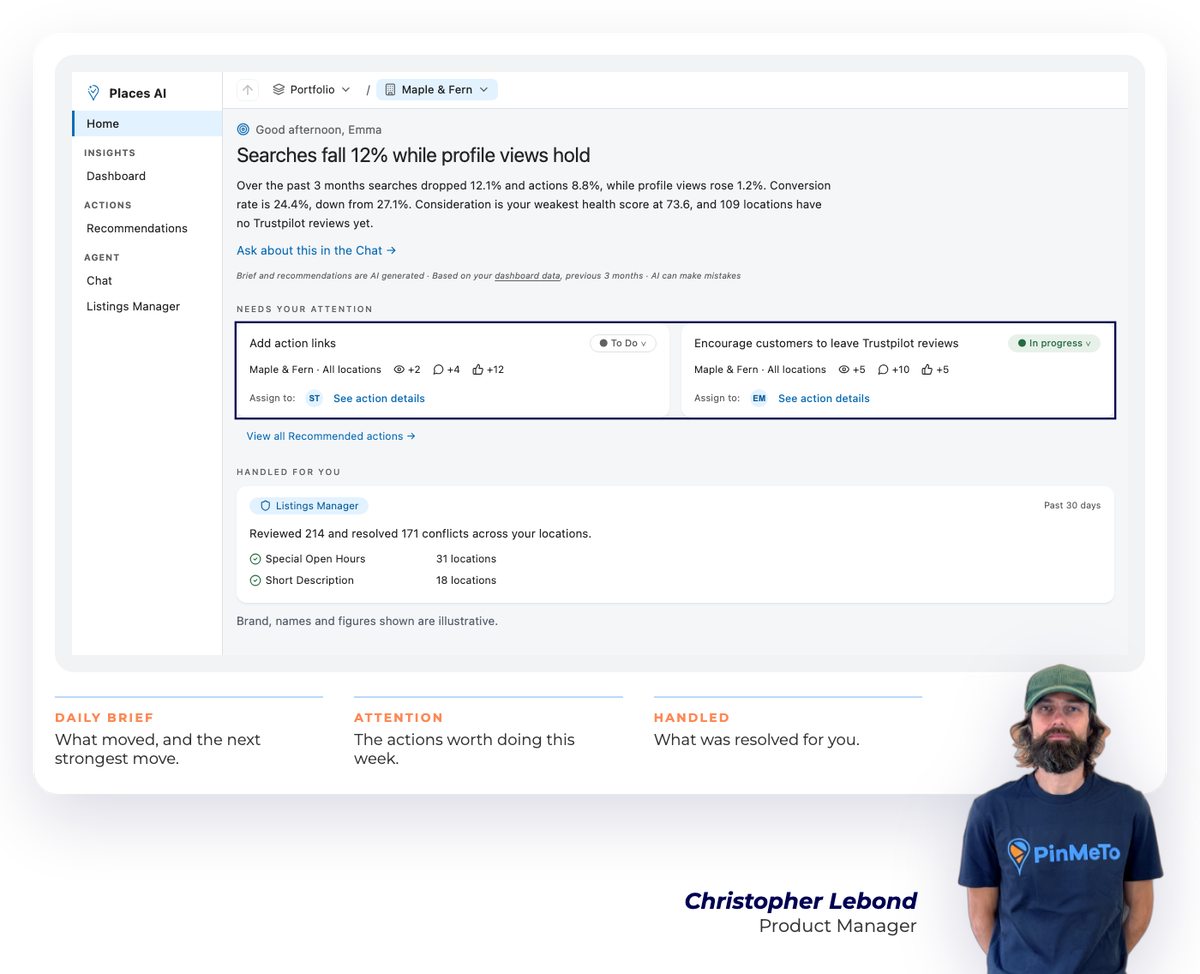
- Opens on Home with a daily brief: what moved, the actions that need attention, and what was handled for you.
- A health score for each stage of a customer finding you: Awareness, Consideration, Decision.
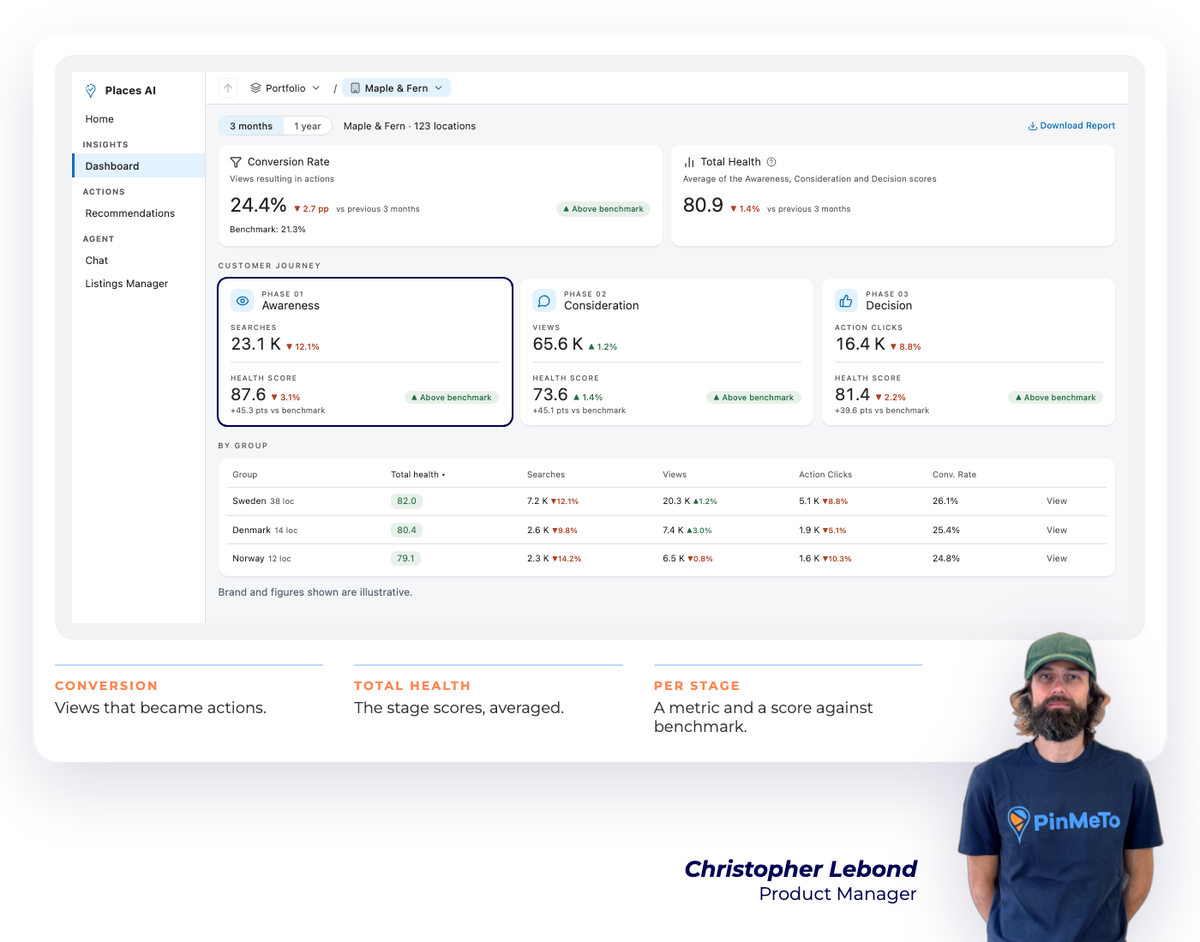
- A conversion rate and a total health score on top: views that became actions, and the stage scores averaged.
- Every score carries a benchmark against a peer group of comparable PinMeTo accounts.
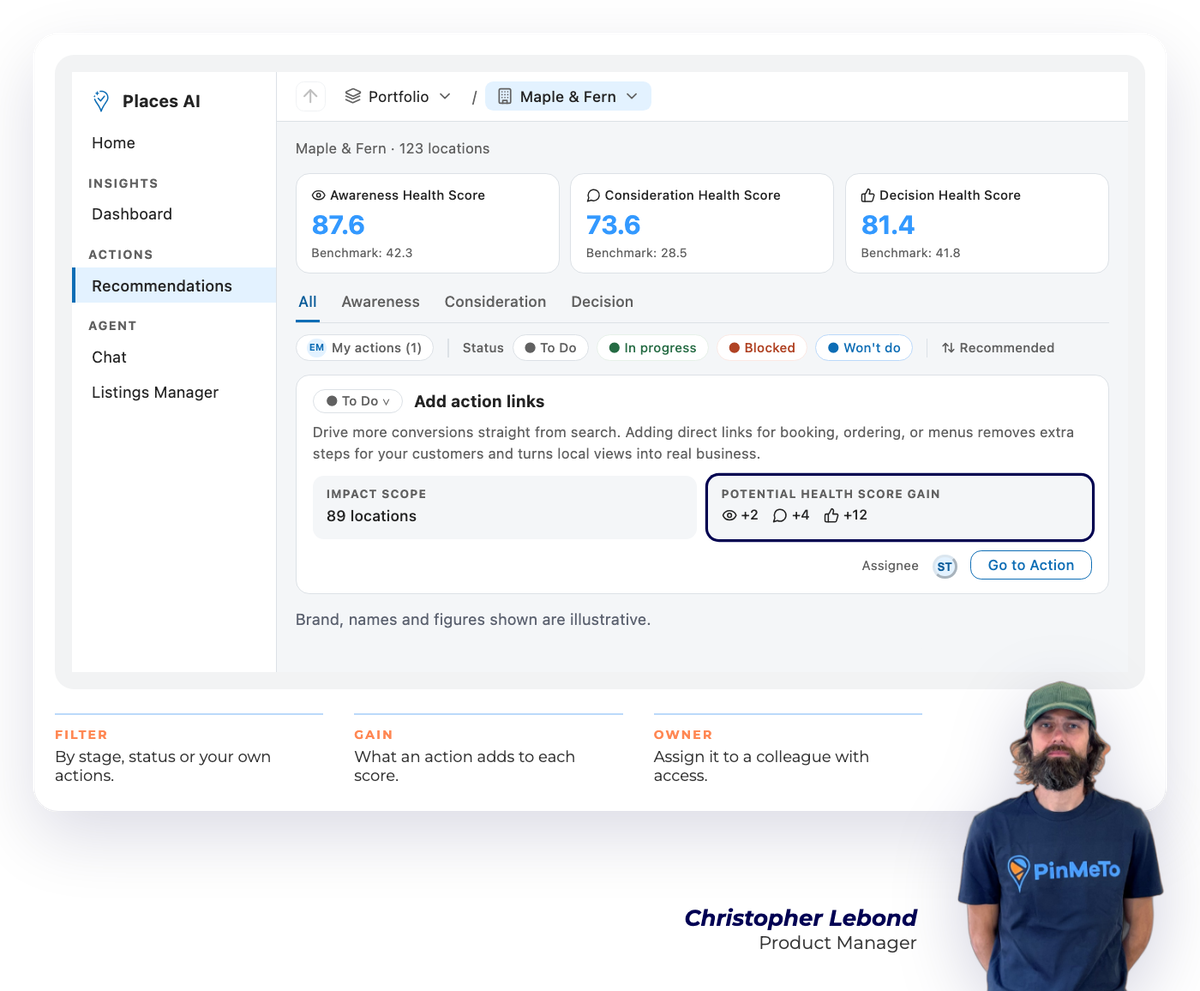
- A ranked list of recommendations, each showing what it would add to a score.
- Actions can be assigned to a colleague, and the list respects who has access to which locations.
- Actions split into organization work that lifts the whole brand and location work for one site.
We have built Places AI to be a rich, ever evolving copilot for achieving your business outcomes. Automation and results are central, as we know that your time, and results, are the most important.
 Christopher Lebond, Product Manager
What you get back
More customers choosing you, for less effort deciding how.
Every stage between a search and a visit leaks customers somewhere: a location missing from a network, hours that are wrong, an action link that goes nowhere. Places AI finds those leaks across every location at once and ranks them by what closing each one is worth, so the fix that brings the most customers back is the one that gets done first. Your team works from one list with owners on it, instead of a monthly report and a guess.
What do the health scores actually measure?
Each score runs from 0 to 100 and covers one stage of the journey from a search to a customer showing intent. On its own it tells you how well that stage is set up today.
Awareness rates whether you can be found at all. It leans heavily on whether your locations are connected to the major search engines, and on whether your core data, the name, the address and the phone number, is accurate.
Consideration rates how attractive your brand looks once someone has found it. This is the rich data: cover images, profile photos, your review rating.
Decision rates how easy it is to become a customer. It looks for the things that remove friction at the last step, which is accurate opening hours, action links that work, and messaging channels somebody actually answers.
Who are you being benchmarked against?
The score tells you where you stand. The benchmark next to it tells you where brands like yours stand, so you know whether a 73 is a lead or a gap, and which stage you are behind on.
Three things define the peer group: your vertical, because a restaurant and a gym have different customer journeys, your size, because the operational problems of five locations and five hundred are not the same problems, and your region.
There is a floor on how small a group can be. A peer group is never built from fewer than three companies, and when a segment would be too small to clear that, the system widens the search until it does. You are comparing yourself to an aggregate, and nobody is comparing themselves to you by name.
How does Places AI decide what to recommend?
In the order that actually changes the outcome, which is networks, then critical data, then rich content. A location that is not connected to a network cannot be found on that network, however good its photographs are, so connections come before everything else.
Every recommendation carries the gain it would add to the score or scores it affects. That is the part that makes the recommendations list usable rather than merely long: two actions that both look sensible are rarely worth the same, and the number tells you which one to do first.
Who picks up the work?
Whoever you assign it to. Recommendations split into two kinds. Organization actions are strategic and brand-wide, like connecting a new network. Location actions are tied to one site, like answering one review, and each one links to the place where the fix is made, so it can be handed to whoever owns that location’s data.
Assignment respects location access. Only people who already have access to the locations an action involves appear in the list, so the feature cannot be used to hand someone work they cannot see, and it cannot be used to find out who works where.
What about brands with more than one account?
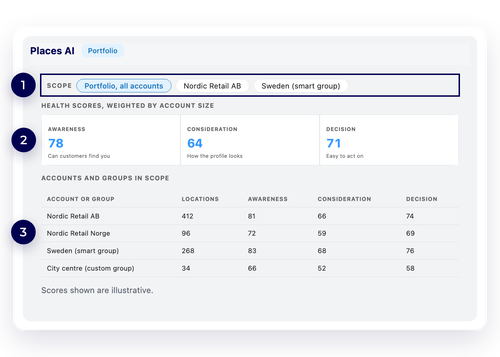
Places AI opens on a portfolio view across every account you can reach, with a scope selector to drill into one. Health scores there are weighted by account size so a large account and a small one can be compared on the same terms. That shipped separately in July, and it has its own write-up.
Where to start
Open Places AI. It opens on Home, with a daily brief written from your dashboard data: what moved since last time, why, and the next strongest move. Under it sit the actions that need your attention and a summary of what Listings Manager resolved for you, so the first screen of the day already tells you whether anything needs a person.
Then open the Dashboard under Insights and read the scores with the benchmark next to each. That takes a minute and it tells you which stage you are actually losing customers at, which is usually not the one people assume. Take the highest-gain recommendation and assign it to whoever owns that work.
Availability
Included for all customers. Full functionality needs Manager access in Listings.

Product Marketing Manager
Ehsan is the Product Marketing Manager at PinMeTo. He has spent his career in product strategy and go-to-market across SaaS and AI companies, leading launches and growth marketing that tie new features to real customer needs. At PinMeTo he writes about product releases, new features, and platform updates, covering what's changing and how multi-location brands can put it to work.
Frequently Asked Questions
What does Places AI do?
What do the health scores measure?
Who are we being benchmarked against?
How does Places AI decide what to recommend first?
What is the difference between an organization action and a location action?
Who can use Places AI?
Subscribe to Our Newsletter
Get local SEO tips, product updates, and marketing insights for multi-location brands delivered to your inbox.
Want to see it on your locations?
See how PinMeTo helps multi-location brands manage listings, reviews, and local search at scale.
Book a Demo