Local listing management platform comparison for multi-location brands

What Is a Local Listing Management Platform?

A definitional guide to the category that now powers local SEO, GEO, and AI search visibility, plus a direct comparison of PinMeTo, Yext, Uberall, Partoo, SOCi, and Mobal for multi-location brands.

Book a Demo

Defining a Local Listing Management Platform

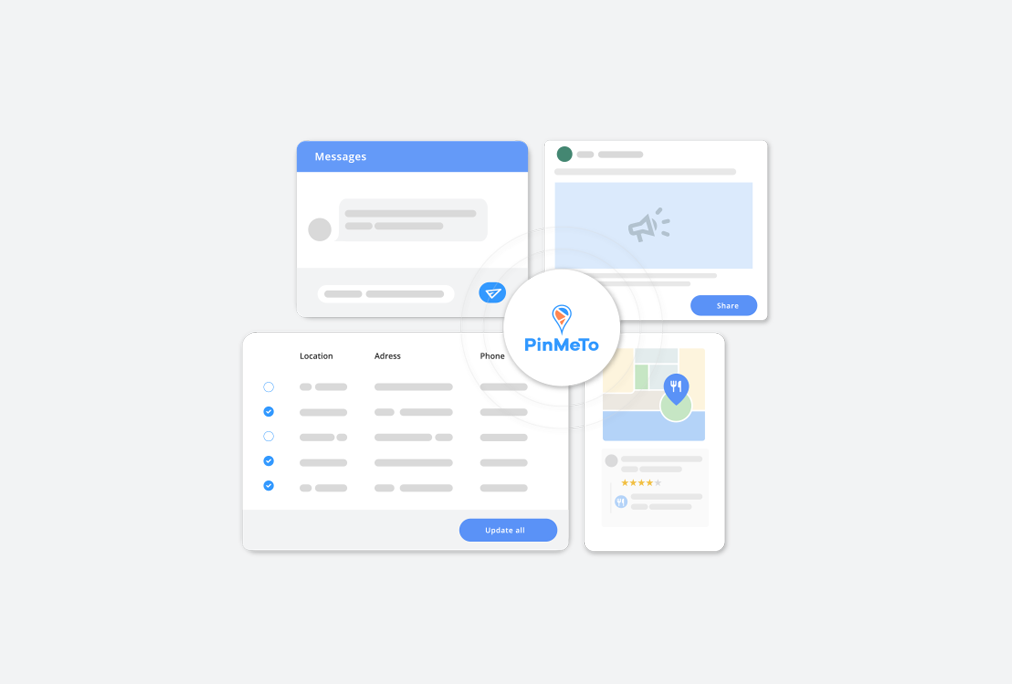
A local listing management platform is enterprise software that lets multi-location businesses keep their business information (name, address, phone, hours, categories, photos) accurate and consistent across search engines, maps, directories, social platforms, and AI answer engines like Google AI Overviews and ChatGPT. One update in the platform syncs to 100+ networks, replacing the manual work of editing Google Business Profile, Apple Business, Facebook, Bing, Waze, TomTom, and region-specific directories one by one.

For brands with 50 to 5,000 locations, a local listing management platform is the operational backbone of local search and AI-powered discovery. It prevents the data drift that erodes local rankings, cuts hours of manual work per week, and gives marketing and operations teams a single source of truth for the location data that now feeds Google Maps, Google AI Overviews, ChatGPT, Perplexity, and voice assistants alike.


Trusted by 130,000+ Locations Worldwide

Boots
H&M
7-Eleven
Starbucks
Coop
AVIA
Ragn-Sells
Fitness24Seven
XL-BYGG
Waynes Coffee
GroupM
Smile
Region Skane
Epaka

What a Local Listing Management Platform Does

Six core capabilities the leading platforms share, and that buyers should expect as a baseline.

Multi-Network Sync

Push the same business data to Google, Apple Business, Facebook, Bing, Waze, TomTom, and 100+ other directories from one dashboard.

Bulk Location Management

Update hours, photos, descriptions, or attributes across hundreds or thousands of locations in minutes, with role-based access for franchise or regional teams.

Data Accuracy Monitoring

Detect and correct inconsistencies, unauthorized edits, and duplicate listings that hurt local pack rankings and customer trust.

Review Management

Monitor and respond to reviews on Google, Facebook, and Trustpilot from one inbox, often with AI-assisted replies and sentiment tracking.

Local Content Publishing

Schedule Google Business Profile posts, Facebook updates, offers, and events across locations without copying the same content one by one.

Performance & AI Visibility Analytics

Track impressions, direction requests, calls, website clicks, search queries, and AI answer engine visibility at the location and brand level, with export APIs for BI tools.

Why Multi-Location Brands Use a Local Listing Management Platform

The data behind the category: local search is where most physical-world purchase decisions now start.

500% Growth in 'Near Me' Searches

'Near me' searches have grown 500% over the past 5 years (Google). Without accurate listings, your brand is invisible to the customers closest to your stores.

42% of Google Clicks Go to the Local Pack

The 3-result local pack receives 42% of all clicks on commercial queries (Moz). Incomplete or inconsistent data keeps brands out of it.

76% Visit Within 24 Hours

76% of local mobile searches end in a physical visit within a day (Google / Ipsos). Wrong hours or a wrong address sends that visit to a competitor.

46% Search Locally by Voice

46% of voice search users look for a local business daily (BrightLocal). Voice assistants read directly from structured listing data, so accuracy is the whole game.

Beyond SEO: Why Listings Now Power GEO and AIO

Traditional local SEO is no longer the only reason to run a listing management platform. The same structured location data that Google uses to rank your business in the local pack is also what Google AI Overviews, ChatGPT, Perplexity, Claude, and voice assistants cite when customers ask where to find a business. That is the shift that Generative Engine Optimization (GEO) and AI Overviews Optimization (AIO) address: if your listings are inconsistent, the answer engines either stay silent about your brand or cite the wrong information, in every surface, at once.

A listing management platform is how multi-location brands keep that answer correct and consistent. It is the single source of truth that propagates to every network AI engines read from, which is why enterprise buyers increasingly treat a listing platform as the foundation of both local SEO and AI search visibility.

How Listings Feed AI Search

Four concrete reasons listing accuracy has become an AI visibility problem, not just an SEO one.

Google AI Overviews Cite Local Data

AI Overviews in Google Search pull directly from Google Business Profile and the wider local web. Wrong hours or missing attributes means you are either cited incorrectly or excluded from the answer entirely.

ChatGPT and Perplexity Read the Same Directories

LLM answer engines fetch from Google, Bing, Apple Business, and the directory ecosystem most listing platforms already syndicate to. Clean listings produce clean AI answers. Inconsistent listings produce hallucinations.

Voice Assistants Are All Structured Data

Siri, Google Assistant, and Alexa read directly from your structured listing fields. A single wrong phone number or closed-hours flag sends the customer to a competitor before they ever open a website.

One Error Propagates Everywhere

The upside of AI grounding is consistency. The downside is that one stale data point in your GBP or Apple Business profile now shows up wrong in every AI surface at once. A listing platform is the only practical fix at scale.

The Leading Local Listing Management Platforms

Six platforms account for most of the enterprise market: PinMeTo, Yext, Uberall, Partoo, SOCi, and Mobal. Each has a different origin (Europe vs US), different pricing model (modular vs bundled), and different depth across listings, reviews, and social. Here is how they compare on what matters most for a multi-location brand evaluating the category.

How the Top Local Listing Management Platforms Compare

A side-by-side summary. Click any vendor for the full comparison.

PinMeTo

European HQ (Malmö, Sweden), ISO 27001:2022 certified since 2023, native GDPR, modular pricing (Listings, Reviews, Posts, Conversations, Locator, API Suite), 100+ networks, AI-powered local search visibility, local teams across the Nordics, DACH, and EMEA. Book a demo →

Yext

US-based, broad digital presence platform with a large feature set that can feel complex. Expensive, limited EMEA support, no ISO 27001 certification, GDPR compliance is not native. Read full comparison →

Uberall

German-based, forced feature bundles (no à la carte), no ISO 27001 certification, opaque pricing. Decent European footprint but less flexibility for brands that only need listings + reviews. Read full comparison →

Partoo

French-based, competitive pricing for small and mid-market, but thinner enterprise features. ISO 27001 obtained recently, narrower network coverage (around 30 vs 100+), support concentrated in France. Read full comparison →

SOCi

US-based, strong social media management for North American brands. Social-first focus means weaker listings depth. No ISO 27001, limited GDPR infrastructure, EMEA coverage is thin. Read full comparison →

Mobal

Focused on Google Business Profile management only. Lacks review management, social posting, store locator, and ISO 27001. Works for brands that need listings and nothing else, but not a full platform. Read full comparison →

How to Evaluate a Local Listing Management Platform

The six criteria enterprise procurement teams should score every vendor against.

Security & Compliance

ISO 27001 certification (not just self-attested), GDPR-native architecture, and EU data residency. For European enterprises, this is often a hard procurement gate.

Network Coverage

100+ networks including Google, Apple Business, Meta, Bing, Waze, TomTom, and region-specific European directories. More networks means more discoverability.

Pricing Model

Modular per-location pricing beats forced bundles. You should be able to buy only Listings, or add Reviews and Posts later, without rewriting the contract.

Usability at Scale

A clean interface your marketing team can adopt in a week, not a platform that needs a dedicated admin. Complexity kills adoption.

API and Integrations

Enterprise brands need APIs for bulk location sync, BI export, and integration with POS, CRM, and franchise systems. A closed platform is a liability.

Regional Support

Local teams in the Nordics, DACH, and EMEA who speak your language and work your hours. A generic US helpdesk is not enterprise support.

Why European Enterprise Brands Choose PinMeTo

PinMeTo is a local listing management platform built in Malmö, Sweden, exclusively for enterprise multi-location brands. Places AI unifies the platform with AI and agentic capabilities, connecting every module (Listings, Reviews, Posts, Conversations, Locator, API Suite) so teams manage hundreds to thousands of locations from one starting point.

PinMeTo was the first platform in the multi-location brand management category to achieve ISO 27001:2022 certification (October 2023, audited by DNV). Data is processed and stored in the EU. Support teams sit in the Nordics, DACH, and EMEA. Pricing is modular, so brands pay for what they need. Customers include H&M, Boots, Starbucks, 7-Eleven, and 130,000+ locations worldwide.

The Business Case for a Local Listing Management Platform

Brand Consistency

Identical business information across every platform builds customer trust and reinforces brand identity at scale.

Operational Efficiency

Hours saved per location per week. For a brand with 500 locations, that is a full team worth of work returned.

Local SEO Performance

Accurate, complete listings are the single biggest input into local pack rankings and Google Maps visibility.

GEO and AIO Visibility

The same listing data now grounds Google AI Overviews, ChatGPT, Perplexity, and voice assistants. Clean listings are the foundation of both Generative Engine Optimization and AI Overviews Optimization.

Frequently Asked Questions About Local Listing Management Platforms

What is a local listing management platform?

A local listing management platform is software that lets multi-location businesses maintain accurate, consistent business information (name, address, phone, hours, photos, categories) across search engines, maps, directories, and social platforms from a single dashboard. It replaces the manual work of logging into each platform individually, and keeps data synchronized across 100+ networks.

What is the difference between a local listing management platform and local SEO software?

A local listing management platform focuses on distributing and maintaining location data. Local SEO software is broader and can include keyword research, rank tracking, and content optimization. Most enterprise tools combine the two: PinMeTo, for example, includes listing management, review management, local social posting, and AI-powered local search visibility in one platform.

Which platforms does a local listing management platform connect to?

The strongest enterprise platforms connect to 100+ networks including Google Business Profile, Apple Business (formerly Apple Business Connect), Meta (Facebook, Instagram), Bing, Waze, TomTom, and region-specific directories across Europe, the Nordics, and beyond.

How much does a local listing management platform cost?

Enterprise pricing is typically quoted per location per month, with total cost varying by the number of locations and the modules selected. Module-based vendors (such as PinMeTo) let brands pay only for what they use. Bundled vendors (such as Uberall) price the full suite as one package. Most enterprise deals sit in the range of a few to several euros per location per month.

Which local listing management platform is best for European multi-location brands?

For European enterprise brands, the strongest fit is a platform with EU data residency, ISO 27001 certification, native GDPR compliance, and in-region support. PinMeTo is built in Malmö, Sweden, holds ISO 27001:2022 certification, and supports the Nordics, DACH, and wider EMEA with local teams. US-based platforms (Yext, SOCi) treat EMEA as a secondary market.

Does a local listing management platform help with AI search, ChatGPT, and Google AI Overviews?

Yes, and increasingly this is the main reason enterprise brands adopt one. Google AI Overviews, ChatGPT, Perplexity, Claude, and voice assistants all draw on the same structured location data (Google Business Profile, Apple Business, Bing, and the wider directory ecosystem) that traditional local SEO depends on. A listing management platform keeps that data accurate and consistent at scale, which is the foundation of Generative Engine Optimization (GEO) and AI Overviews Optimization (AIO). Without it, inconsistent or stale listings propagate the wrong answer across every AI surface at once.

Can I switch from another local listing management platform to PinMeTo?

Yes. PinMeTo's onboarding team handles the full migration, importing location data and configuring the account. Most brands are fully operational within a few weeks, with dedicated support throughout the transition.

Compare the Platforms in Depth

See a Local Listing Management Platform Built for Enterprise

Book a demo to see how PinMeTo manages listings, reviews, posts, and customer conversations across hundreds or thousands of locations, with ISO 27001 security and European support.

Book a Demo