Location Marketing Buzzwords You Needed to Know in 2019
Originally published
- Multi-Location
- How-to Guides
This glossary isintended to be a quick reference guide for Marketers, Social Media Managers, and anybody else interested in learning about or brushing up on their location management vocabulary. Let’s dive in.
Ads
API is an abbreviation for Application Programming Interface, which is a technical word for a set of rules that allows two systems to exchange data. In layman’s terms, an API allows two pieces of software to communicate with one another. It is the digital counterpart of an adaptor that allows you to charge your phone while travelling overseas, or, perhaps more aptly, a translator that allows two people to communicate while speaking different languages.
Awareness
The brand or your brand refers to the images, logos, slogans, and general descriptions associated with your company.
Branded search
The company brand page on Facebook is essentially a mini-version of your website. It should not have a physical address, but should rather reflect the organisation as a whole. If properly configured, it will also provide a “locations” tab where users can see each of your local stores, complete with logo and any important business information. It is worth mentioning that Facebook has a history of gradually decreasing brand page exposure in terms of the visibility of material shared on the platform. The more the number of fans a brand page has, the fewer people will see unpaid posts to that page in their feed.
Business Accounts
Check-ins generate a “was here” status on Facebook and have the inverse value of fans. Check-ins generate a higher amount of impressions in a shorter period of time than fans, making them ideal for social advocacy and brand exposure. There is no universal system for collecting check-ins, and the frequency varies greatly by industry. In general, the more desirable it is to be linked with a location or activity, the higher the number of check-ins. Hotels, gyms, spas, restaurants, cafes, and coffee shops, for example, have considerably more check-ins than other typical stores.
Claimed
Cost Per Click is a common metric for advertising sales and bases the price on the number of clicks on a piece of content. CPC is often used when marketing has a set daily budget. Once the budget is reached, the ad is removed from rotation for the day. CPC can also be used retrospectively as part of a deeper analysis into the cost of acquiring a new customer.
CPM
The customer journey in this context is mostly concerned with online to offline behaviour. That is, purchases made in a local store that started with some type of digital activity, such as a search. Removing as many steps as possible between a search and actionable results is a big part of simplifying the customer journey. One of the most effective ways to simplify is to have local stores publicised and visible in as many places as possible.
Driving Directions
These are directions generated automatically after clicking on directions from a local store page. Generally, these will only occur on mobile devices and will open a default map service on that device.
Direct searches
Discovery searches are the consequence of someone searching for a product or service and may include “near me” features. Discovery searches are crucial because they reveal how frequently someone has made a purchasing choice and your company appears as a potential source. These are especially important for those who rely significantly on impulse purchases, as the closest location may become the preferred provider. The more frequently your locations appear in discovery searches, the more likely you are to earn the customer’s business and steal a possible purchase away from a competition. Discovery searches rely significantly on having your Google locations properly configured. This includes information such as free wifi, outdoor seats, and so on.
Engagement
Fans
Facebook Business Manager
here. One notable difference between Google and Facebook is how companies are structured. In Facebook, you company will consist of one or more Brand Pages with a Location Structure nested beneath. In other words, there will be a layer that represents your brand as a whole as well as individual Facebook locations for each of your stores.
Facebook Packs
This is Foursquare’s business portal with guides for getting started publishing, claiming, and maintaining your local stores on Foursquare. You can read more here. The value of Foursquare cannot be understated as it acts as a source of local store information for over 100,000 apps and services globally. While many people will be vaguely or completely unfamiliar with Foursquare changes are that the average person uses their data multiple times a day via apps and services on their mobile devices.
Google My Business
here.
Google Packs
Impressions are a type of visibility metric that is frequently used as a criterion for ad sales (See: CPM). The only criteria in calculating impressions is how many times something was seen. Impressions ignores distinct individuals and only counts overall views. As a result, impressions can often be deceptive, as one individual can conceivably generate an infinite number of impressions.
Insights
Key Performance Indicators are specific metrics chosen to help determine how successful a marketing activity has been. These can be comprised of any number of measurable variables (See: Insights) or cost analysis (See: CPM and CPC). Correctly determining KPIs can help a company understand where they should focus their marketing activities and in some cases, even when those activities should take place.
Likes
Location structures are the methods through which local stores are added and managed in a given business account. These vary by network, but Facebook is the most well-known. Because Facebook and Instagram both support locations, if the locations are properly published on one, they will be taggable on the other. Facebook location structures also enable for the building of a searchable map that may be shown on the company brand page. This map will display all Facebook Business account locations, regardless of nation. Location structures effectively generate a native version of your website’s store locator on Facebook, but with the added benefit of social interactions. Each network has its own set of regulations about location structures, which must be followed.
Location Page
Local Search Engine Optimisation is a modern phrase that focuses on ensuring that local store information is not only correct, but also optimised for maximum exposure (See: Network Optimisations). These local SEO initiatives not only help to streamline the customer journey as much as possible, but they also help to boost a company’s overall SEO efforts by ensuring that information about local stores is consistent across networks.
Location descriptors are unique to Facebook and serve as a geographical reference to a specific location. They are not and should never be full addresses. Landmarks such as public squares are examples of location descriptors, and if your store is the only one in a city, the city name is also appropriate. Location descriptors are easily recognisable because they come within () after the company name. PinMeTo in Stockholm, for example, will appear on Facebook as PinMeTo (Stockholm). If there were more than one in Stockholm, additional particular names would be required, such as PinMeTo (Gamla Stan). Following these names will not only enhance your general visibility on Facebook, but will also help your SEO position on Google.
A properly set up Google My Business account will mean increases in all Google metrics, including map views. If all of your locations are published and verified on an account that you own, you open up the possibility for the nearest three locations to be shown in what is known as a Google Pack (See: Google Packs). These packs make it extremely convenient for users to identify the closest location suiting their needs as well as access all the information needed to contact that location or get directions to the store.
Naming Conventions
This is another broad term encompassing any activity, account set up, or updating of business information that provides the maximum exposure on the given network. Where companies often damage their own exposure is by violating individual network guidelines, in particular with regards to naming of local stores. Google determines ranking in part based on how many times it sees the same store information in different places and many companies, while well intentioned, unintentionally reduce the effectiveness of their own SEO expenditures by not optimising their locations across networks.
Organic Impressions
This is essentially exactly the same as organic impressions (See: Impressions) except that it only counts unique individuals and not views.
Paid impressions
This is essentially exactly the same as paid impressions (See: Impressions) except that it only counts unique individuals and not views.
Phone Calls
Reach is a measure of online visibility but it differs significantly from impressions in that it counts single views from unique individuals. For that reason, counting reach over time becomes difficult if not impossible. The reason that reach is not often used as a metric is that unique individuals must be counted only once per span. That means that if a company attempts to calculate reach over a week, they must remove duplicate views for unique individuals for each day. It also means that if you ever see that your reach is higher than your impressions, something has likely gone very wrong. For this and other reasons, impressions is generally the metric of choice for advertising campaigns and insights.
ROI
Searches as an insight are a measure of how many times a location was shown to a user as a result of some sort of query. These can be the result of a number of criteria such as name, category, or even “near me” queries on multiple networks. As a rule, companies want to show up in as many relevant searches as possible. When it comes to impulse purchases in particular, showing up in a search can be a deciding factor in a purchase decision.
SEO
Unofficial is a term describing content or pages that are not owned and maintained by the parent company. On Facebook these are especially problematic as unofficial pages can be created simply by attempting to check-in to a location. If Facebook cannot find the proper location a new page will be created representing that place. These pages often lack proper branding and business information and the companies rarely know that they even exist. These pages can become quite popular over time which is also problematic for businesses as they are missing out on valuable organic and viral exposure while simultaneously having content online that damages both their brand and SEO efforts.
User Edits
User edits are a set of tools that allow users on various networks to recommend modifications to locations, whether they are owned or not. In many circumstances, users can recommend any number of changes to a certain location, such as a new phone number, website, email address, opening hours, or even that the business be permanently closed. User edits become even more problematic for multi-location companies because there is no clear direction on how or why these edits are accepted, and there may not be an alert in every case. Because of this well-intended collection of services, marketers must be extremely vigilant in ensuring that local shop information is correct.
Viral Impressions
Viral
These visits refer specifically to local websites, not a corporate landing page. So if your company is called “Blue” and you have stores in Malmö, a website visit to www.Blue.com would not count here. Instead, it would require a visit to www.Blue.com/Malmö or similar.

Recommended Articles
Local SEO Ranking Factors 2026: A Practical Guide for Multi-Location Brands
A 2026 guide to local SEO ranking factors: Google's relevance, distance, and prominence, plus AI Overviews, review recency, and multi-platform strategy.
Astghik Nikoghosyan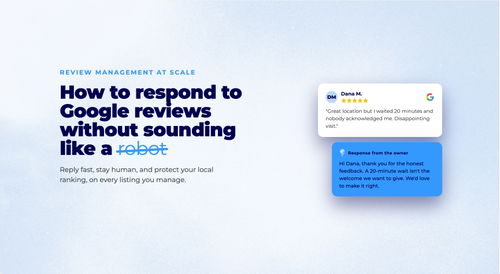
How to Respond to Google Reviews at Scale Without Sounding Like a Robot
Manage review responses across dozens of locations without losing authenticity. Templates, timing, and a workflow for enterprise-scale review management.
Daniel Melkersson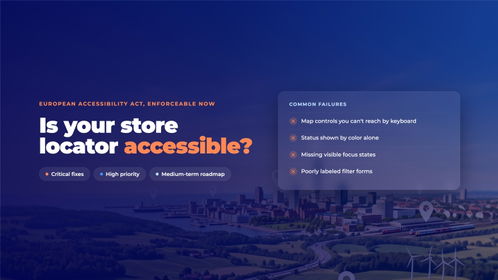
Is Your Store Locator EAA-Compliant? A Checklist for Multi-Location Brands
The European Accessibility Act is now enforceable. Audit your store locator for WCAG 2.2 compliance with our practical checklist.
Marcus OlssonSubscribe to Our Newsletter
Get local SEO tips, product updates, and marketing insights for multi-location brands delivered to your inbox.
Ready to boost your local visibility?
See how PinMeTo helps multi-location brands manage listings, reviews, and local SEO at scale.
Book a Demo